


The Construction Execution Stack
The construction industry is one of the largest and least productive industries in the world. Global spend exceeds $13 trillion annually and is projected to grow to $22 trillion by 2040. Despite this scale, construction productivity has grown at only 0.4% annually over the past two decades - roughly one-fifth the rate of the broader economy, and one-seventh the rate of manufacturing.
The execution layer is where projects succeed or fail. An owner funds the work and sets the deadline. A general contractor wins the bid and takes responsibility for the schedule. Subcontractors execute the physical work. And somewhere in the middle, a project controls team is supposed to hold it all together - tracking progress, flagging delays, forecasting cost, and updating the schedule.
The tools they use to do this are a disaster.
The Monopoly Nobody Loves
In 1983, Joel Koppelman and Dick Faris founded Primavera Systems in Pennsylvania to build project management software for the construction industry. Over the next two decades, their flagship product - Primavera P3 - became the standard for CPM scheduling on major construction projects. In 1999, Primavera acquired Eagle Ray Software, whose enterprise scheduling product became the foundation of what eventually shipped as Primavera P6 in 2007. Oracle acquired Primavera Systems in 2008 for a reported $600 million.
P6 now has dominant market share across large construction projects globally. It is required by contract on most government and infrastructure work. It is taught in every construction management program. If you're running a $500M project anywhere in the world, someone on that project is maintaining a P6 schedule.
It is to construction what Excel is to finance: the connective tissue between every firm, every contract, and every milestone in the project.
The "required by contract" detail matters more than it sounds. P6 isn't dominant because people love it. It's dominant because owners mandate it, because it's what schedulers know, and because decades of project data, WBS templates, and baseline schedules live inside its proprietary XER file format. Nobody switches schedulers mid-project. Nobody switches between projects if they can avoid it. The switching cost isn't software cost - it's retraining an entire profession.
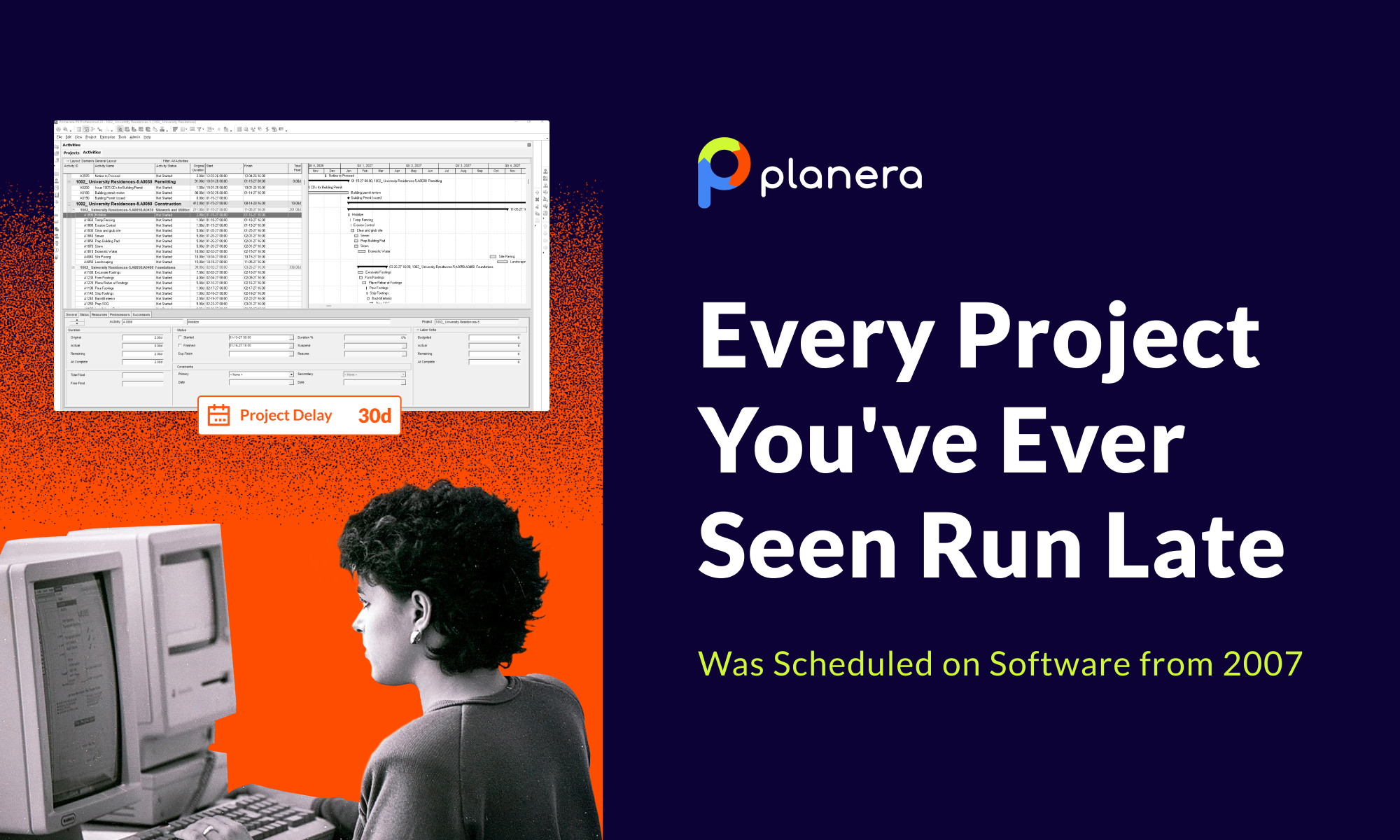
Oracle has done little meaningful innovation with P6 since acquiring it. The interface looks nearly identical to what it did fifteen years ago. Real collaboration doesn't exist - schedulers maintain their own copies, exchange XER files over email, and reconcile changes manually. Updates from the field have to be translated into schedule logic by hand. It is, in the most literal sense, the construction equivalent of emailing Excel spreadsheets back and forth.
The Cost of Getting This Wrong
The numbers are not subtle. According to IDC research commissioned by Procore, 77% of construction projects finish late and 75% exceed their planned budgets - on average, 70 days behind schedule and 15% over cost. For large projects, McKinsey finds the numbers are worse: overruns of up to 80% on cost and 20% on schedule are common.
The deeper problem is how decisions get made - or don't. A scheduler sitting in an office is maintaining a model of what's supposed to happen on site. The field is executing against a different reality. The gap between them is where projects fall apart. By the time a delay shows up in the master schedule, it's already weeks old. By the time recovery options get evaluated, the window to act cheaply has passed.
Think of it like navigating with a map that's three weeks out of date. You're not wrong because you're bad at navigation - you're wrong because your information is stale and you had no way to know it.
Why Now
For a long time, you couldn't close that gap with software. Schedule updates required a trained scheduler to interpret what was happening on site and manually translate it into CPM logic. There was no way to automatically reason over a 10,000-activity network and surface what actually mattered.
Three things have changed this:
First, AI can now reason over complex, partially-structured project data in ways that weren't possible before. A schedule isn't just a list of activities - it's a web of dependencies, resource constraints, and contractual commitments. AI can navigate that web, identify which delays cascade and which don't, and surface early warning signals before they become crises.
Second, the infrastructure buildout driving construction demand has created genuine urgency. Data centers, semiconductor fabs, grid modernization, hospital construction - these are high-stakes, time-critical projects where schedule compression isn't optional and the cost of delay is enormous.
Third, mobile hardware has finally made field data capture tractable. Foremen can log daily progress from a phone. That data can flow into a planning system in real time, closing the gap between the schedule and site reality.
Three Ways to Attack This Market
Given a dominant incumbent that hasn't innovated in over a decade, a fragmented execution chain running on manual coordination, and technical unlocks that have only recently aligned, it's worth being precise about how the market actually gets disrupted.
Attack P6 directly. Build a better scheduling platform from scratch - cloud-native, collaborative, AI-enabled - and win at the authoring layer. The historical graveyard is full of attempts. P6's dominance is reinforced by contractual requirements, professional training, and decades of project data in a proprietary format. You're asking owners to change their contracts, schedulers to retrain, and GCs to trust a new system of record on their most complex work.
Build the collaboration and field execution layer around P6. Don't fight it on its own turf. Own the workflows P6 handles poorly - which is most of them. P6 is a planning tool; it was never designed for field execution, daily progress tracking, or cross-team coordination. The work that happens around the schedule - foreman planning, subcontractor lookaheads, daily reports, variance tracking - is almost entirely disconnected from the master schedule. Own that layer, create the feedback loop between the field and the plan, and use that foothold to expand. Nobody replaced SAP by building a better ERP. They built around it until SAP became the plumbing nobody touched.
Go after the intelligence layer on top of the schedule. P6 stores the data but can't reason over it. A 15,000-activity schedule has thousands of potential float paths, dozens of critical sequences, and no automatic answer to the question a project executive actually needs: "Are we going to finish on time, and if not, what do we do about it?" AI can answer that - not by replacing the scheduler, but by doing in seconds what used to take days of manual analysis.
Planera
This is exactly the space Planera is building in.
The insight behind Planera is that the scheduling problem isn't primarily a data problem - it's a collaboration and decision-making problem. The master schedule lives in P6. The weekly plan lives in someone's head, or a spreadsheet, or a whiteboard. The two are supposed to be the same thing, updated continuously as work progresses. In practice, they diverge almost immediately and stay diverged.
Planera connects the planning hierarchy - master schedule, look-ahead, and weekly work plan - on a collaborative canvas that office and field teams can both use. Subcontractors can see what's expected of them. Foremen can report progress without a scheduler in the loop. Constraint logs flow into planning instead of sitting in a notebook.
And then there's Manny, Planera's AI assistant. Manny doesn't replace the scheduler; it makes the scheduler ten times more effective. It can analyze a schedule for CPM logic violations, flag activities at risk of becoming critical, surface DCMA-14 health metrics, and answer the questions a project executive needs answered before a status meeting - in seconds, not hours.
The wedge is field execution and collaboration, where the pain is acute and the competition is weak. The expansion is schedule intelligence, where the value is high and the incumbents have nothing.
The built world is behind schedule. The software it runs on hasn't been meaningfully updated in almost two decades. That's about to change.
You deserve better scheduling software.
Drive revenue, reduce costs, and manage scheduling with Planera.
Request a Demo