

Breaking Free from Legacy Limitations and the "Scheduling Fog"
To understand the impact of Planera, one must first look at the frustrations field leaders experienced with the status quo. Legacy scheduling platforms often served as a barrier rather than a tool.
Pete Robinson, a General Superintendent for Big-D Southwest managing a complex historical school rebuild in Arizona, recalls his past experiences. "I've always been handed a schedule and said, 'Here, this is what we got to do,'" Robinson noted. He observed that P6 seemed to be one of the hardest things in the world to learn, which previously led him to leave the scheduling entirely to others.
James Rollins, a Superintendent for Big-D Lindon overseeing the construction of a high-end temple in Colorado Springs, echoed this sentiment. He frequently had to rely on a scheduling consultant to navigate legacy tools, noting, "I honestly don't know how P6 has made as much money... because it strikes me as extremely convoluted, and a lot of people just avoid it".
Jovanni Guevara, a Senior Superintendent at Balfour Beatty currently working on a new seven-story bed tower and utility plant expansion in Texas, agreed that legacy tools held the field back. "P6 is a little bit not user friendly, so it's a little tough to get the hang of it," he explained.
Without a user-friendly master schedule, superintendents like Sonny Greenwood of Big-D Food & Beverage resorted to manual workarounds. "I do Excel... That's all I've done my whole career," Greenwood noted regarding how he previously built his six-week lookaheads.
Jeremy Easen, a Superintendent at Creative Contractors managing an elementary school and a historic theater project in Tampa, highlighted the fundamental danger of this disconnect. When superintendents are forced to make disconnected short-term schedules, they lose sight of the big picture. He noted that there was always a "two to four week fog" when changes happened on a site, where teams weren't really sure how daily adjustments were affecting the overall master schedule.
The Planera Difference: Visual, Intuitive Ownership
Planera replaces the technical friction of legacy platforms with a visual, whiteboard-style Canvas that mirrors how builders naturally think. This approach has empowered superintendents to stop relying on project managers for updates and take active control.
Rollins praises this visual approach, noting how easily it correlates with his ability to "pop in a bubble, add an activity, draw the arrow, [and] make the connection". Guevara similarly loves the visual layout for his hospital projects, noting that it "feels like a big bulletin board" that easily shows where everyone is at.
Robinson found Planera so intuitive that he figured it out primarily through trial and error. "I get to control it. I get to move it around. I get to re-sequence it," Robinson said, noting how empowering it is to finally build the schedule himself.
For Greenwood, the software's ease of use inspired him to take full ownership of his project's timeline from the project manager. "I used to be my project manager who did it, but I say, 'Now I'm going to take that out of your hands, and into mine, so I drive that sh*t now,'" Greenwood explained.
Easen noted that the shift at Creative Contractors was immediate. "The best part of it is that people aren't sitting back waiting for the new schedule to be issued... You're not handed something that you're stuck with, you can figure it out yourself".
Driving Subcontractor Accountability and Alignment
A schedule is only valuable if the entire project team is aligned with it. Because Planera is cloud-based and highly accessible, superintendents are using it to drive unprecedented collaboration with their trade partners.
- Live Subcontractor Meetings: Greenwood actively shares the Planera schedule live in his subcontractor coordination meetings in Denver. "I just pop that up there and I can show them. 'Hey, this is what we all agreed... this is our schedule,'" he stated.
- Visualizing Cause and Effect: Guevara takes a similar approach at Balfour Beatty, pulling up the Canvas view so subcontractors can clearly see the dependencies of their work. "It shows relationships with activities. It's pretty neat to show these subs that, hey, this is what happens if you don't get done this," Guevara explained. "It kind of puts a little bit more accountability. Hey, you need to get things done based on the duration you told me".
- Master Schedule Continuity: For Easen, Planera finally solved the disconnect between field lookaheads and the master contract schedule. Previously, subs would compare the Excel lookahead to the master schedule and find no continuity. "Somebody was making spaghetti and somebody was making lasagna, and it kind of tasted the same, but it wasn't the same thing," Easen joked. Now, because the lookahead is pulled directly from Planera, there is a single source of truth.
The ROI: Massive Time Savings and Procore Integration
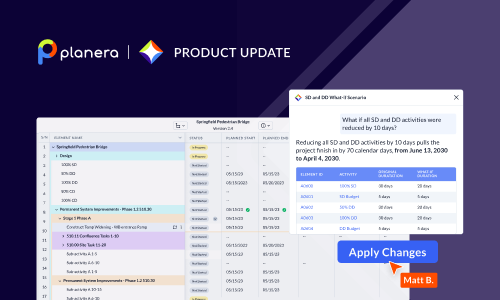
By putting the schedule in the hands of the field, companies have eliminated the bottlenecks that plague traditional construction projects. Superintendents no longer have to wait days for a back-office scheduler to test a "what-if" scenario; they can adjust sequences on the fly.
This agility comes with massive time savings. Easen noted that under the old system at Creative Contractors, "People would spend three quarters of a day or more on a stinking look ahead schedule". Now, they can simply filter the Planera schedule and print it out for their meetings.
Greenwood experienced the exact same transformation. "I can go in and do it myself, and I can be done in 15-20 minutes, when it used to take me hours... Now I can just get in there and I can update my schedule and on the fly," he shared.
Robinson agreed, noting that schedule maintenance now requires minimal effort: "If I spend a half an hour, 15 minutes here and there, you know, every day, it really is almost no time at all".
Furthermore, superintendents are leveraging Planera's seamless integrations to keep all their data in one place. Robinson publishes the Planera schedule directly to Procore so that it is visible to all of his subcontractors without requiring them to switch between applications. "I'll have my daily log, I'll have my drawings, and then I have the Procore Planera open... it's just much easier to maneuver," Robinson noted.
Conclusion: A Permanent Shift in Construction Culture
Planera is proving that superintendents can—and should—be the active masters of their own schedules. By replacing siloed, highly complex software with an intuitive, collaborative platform, Big-D Construction, Balfour Beatty, and Creative Contractors have broken down the barrier between the office and the field.
For these field leaders, there is no going back to the old way of doing things.
"It's so simple for anybody to use, and I'm already telling all the subcontractors, Hey, y'all should definitely use this," Guevara said. "This one I take full ownership of the schedule... I don't think I want to go back to P6".
Robinson summarized his experience with similar conviction: "Now that I know that this exists, I don't know why any other program would be used... My honest opinion".
Rollins echoed the exact same sentiment regarding his transition to Planera: "I said goodbye to the past, and I never want to go back to it".
.png)
.webp)
