
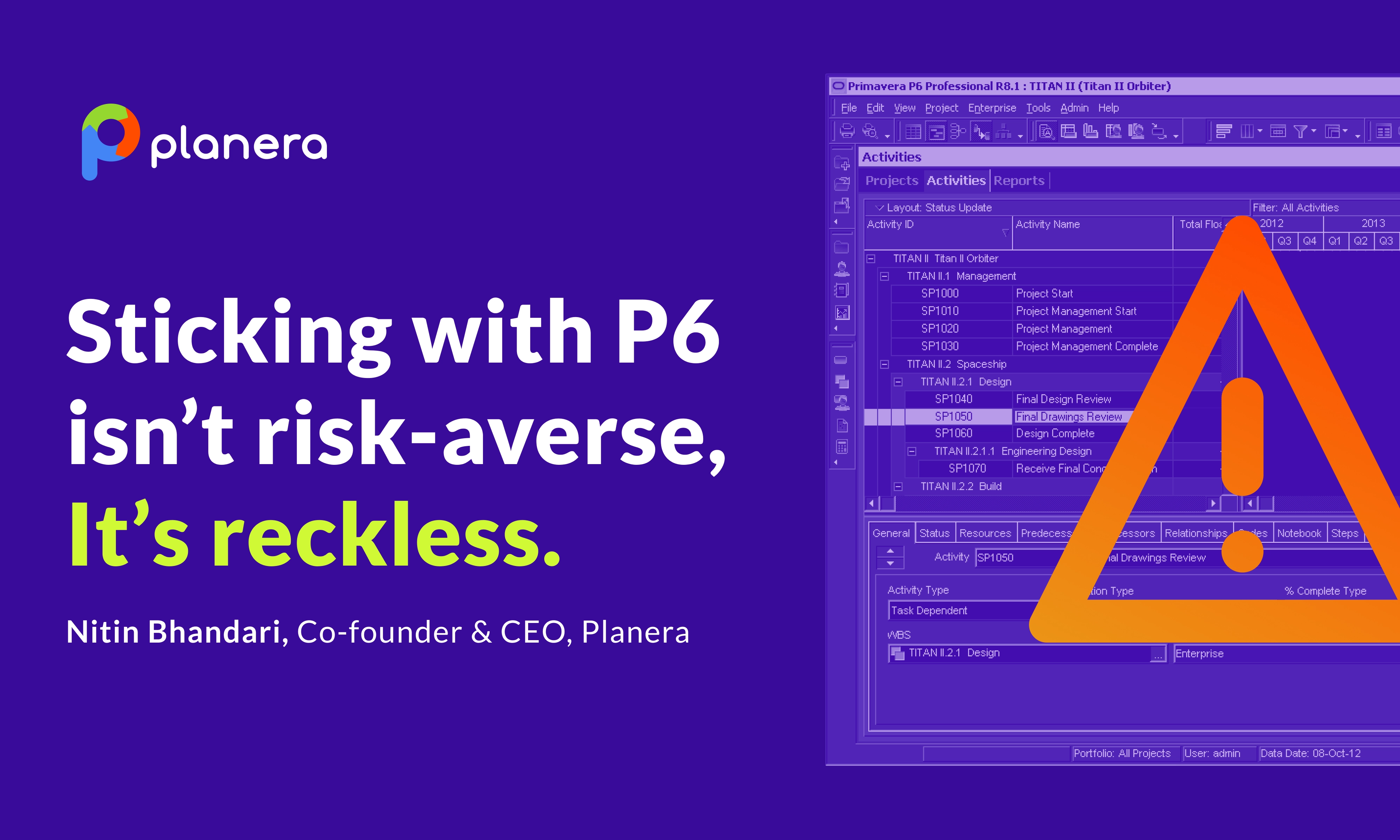


I WANT TO SAY SOMETHING that a lot of people in construction technology are too polite to say out loud: if your scheduling software was built before the iPhone existed, it is not a tool anymore. It's a liability you've learned to live with.
Primavera P6 turns 30 this decade. Think about what that means. P6 predates smartphones, predates cloud computing as we know it, predates the entire concept of "software as a service." It was designed for an era when a scheduler's job was to sit alone in an office, manually keying in updates from paper reports, and producing a Gantt chart that maybe five people on a project ever actually looked at.
That was a reasonable way to build software in the 1990s. It is an indefensible way to run a multi-hundred-million-dollar construction program in 2026.
“If your scheduling software was built before the iPhone existed, it is not a tool anymore. It's a liability you've learned to live with.”
And yet, across our industry, P6 remains the default. Not because it's good. Because it's familiar. Because "nobody ever got fired for buying P6."
I understand the instinct. Construction is a risk-averse business, and it should be — we build hospitals and bridges and data centers, not photo-sharing apps. But there's a difference between being risk-averse about your structural engineering and being risk-averse about your project management software. One of those choices can kill someone if you get it wrong. The other one is just costing you money, every single day, and you've convinced yourself it's fine because everyone else is losing that money too.
Here's what's changed, and why standing still is no longer a neutral choice.
Complexity Outgrew the Tool
Start with a fact that schedulers feel every day but rarely see stated plainly: our projects have gotten exponentially more complex, and legacy tools were never built for this scale.
Under standard CPM scheduling benchmarks — DCMA and AACE guidelines both point to this — a reliable schedule needs roughly 1.5 to 2 logic ties per activity to actually hold up under scrutiny. That means even a routine commercial project under $20 million can easily involve 300 to 500-plus interconnected dependencies.
300–500+ interconnected dependencies on a routine commercial project under $20 million
Now stretch that same math across a $500 million program. You're not looking at a bigger version of the same problem — you're looking at a web of dependencies so dense that no scheduler, no matter how sharp, can hold it all in their head, and no thirty-year-old desktop application was ever architected to represent it, let alone let you interrogate it in real time.
P6 was built for projects an order of magnitude simpler than the ones we're delivering today. Complexity outgrew the tool a long time ago; we just kept using it anyway.
AI Moved the Baseline
And it isn't only complexity working against legacy software. We are in the middle of the fastest transformation construction technology has ever seen, and it's being driven by AI.
Not AI as a buzzword bolted onto a marketing slide — real AI that can build a baseline schedule from a set of drawings in minutes instead of days, that can run constructability reviews automatically, that can flag schedule risk before it becomes a six-month delay claim. This capability didn't exist three years ago. It exists now.
And P6 makes no use of it. None. It is, by design, a static, manual, single-user tool built for a scheduler to fight with alone. There is no roadmap where legacy CPM software wakes up one day and becomes an AI-native platform. That's not how thirty-year-old software architecture works.
The Real Cost of the Status Quo
So let's talk about what this actually costs you, because I think the ROI conversation is where the status-quo argument completely falls apart.
Every week a senior scheduler spends re-keying trade partner updates into a master schedule is a week they are not spending on the things that actually protect your project: recovery planning, risk analysis, coaching your project teams, giving your executives real portfolio-level insight instead of a static PDF export.
That's not a hypothetical trade-off. That's the literal difference between scheduling as data entry and scheduling as the strategic function it should be. When you free your best scheduling talent from typing and chasing updates, you don't reduce the value of that role — you multiply it. Same headcount, dramatically more leverage.
“Same headcount, dramatically more leverage.”
That's not a nice-to-have. On a program of any real size, that's real money, measured in avoided delay claims, faster recovery from disruption, and schedulers who can actually cover a full portfolio of projects instead of drowning in one.
The Sidelines Aren't Neutral
I want to be direct about who this message is for. If you are a general contractor or an owner and your position is "we'll wait and see" — I'd ask you to think hard about what you're actually waiting for.
You are not being prudent. You are choosing, actively, to let your competitors get faster, cheaper, and more accurate at the exact same time you're standing still. The ROI on modern AI-based scheduling tools is not marginal. It is large enough that the "safe" choice — staying on legacy software because it's familiar — is now the riskier one.
The sidelines aren't neutral ground anymore. They're where you fall behind.
Let Schedulers Schedule
This is not an argument against scheduling expertise. Quite the opposite — it's an argument for finally putting that expertise where it belongs.
The best schedulers I know didn't get into this profession to spend their careers as data-entry clerks for a thirty-year-old application. They got into it to solve hard problems: to see risk before it materializes, to build recovery plans that actually work, to be the person in the room who understands the full picture of a project better than anyone else. Legacy tools like P6 don't support that work. They bury it under administrative overhead.
The construction industry doesn't need to be told that change is coming. It's already here, and it's moving faster than most of our software has. The only real question left is whether you're going to lead that shift on your own projects, or wait until your competitors have already done it for you.
This article originally appeared in an ENR email to subscribers on October 25, 2026. Nitin Bhandari is co-founder and CEO of Planera, an AI-native construction scheduling platform.
For a closer look at what replaces P6, read P6 Set the Standard. We're Raising It., or book a demo to see AI-native CPM scheduling on your own schedule.

You deserve better scheduling software.
Drive revenue, reduce costs, and manage scheduling with Planera.
Request a Demo