


This article originally appeared in Buildings on September 25, 2026.
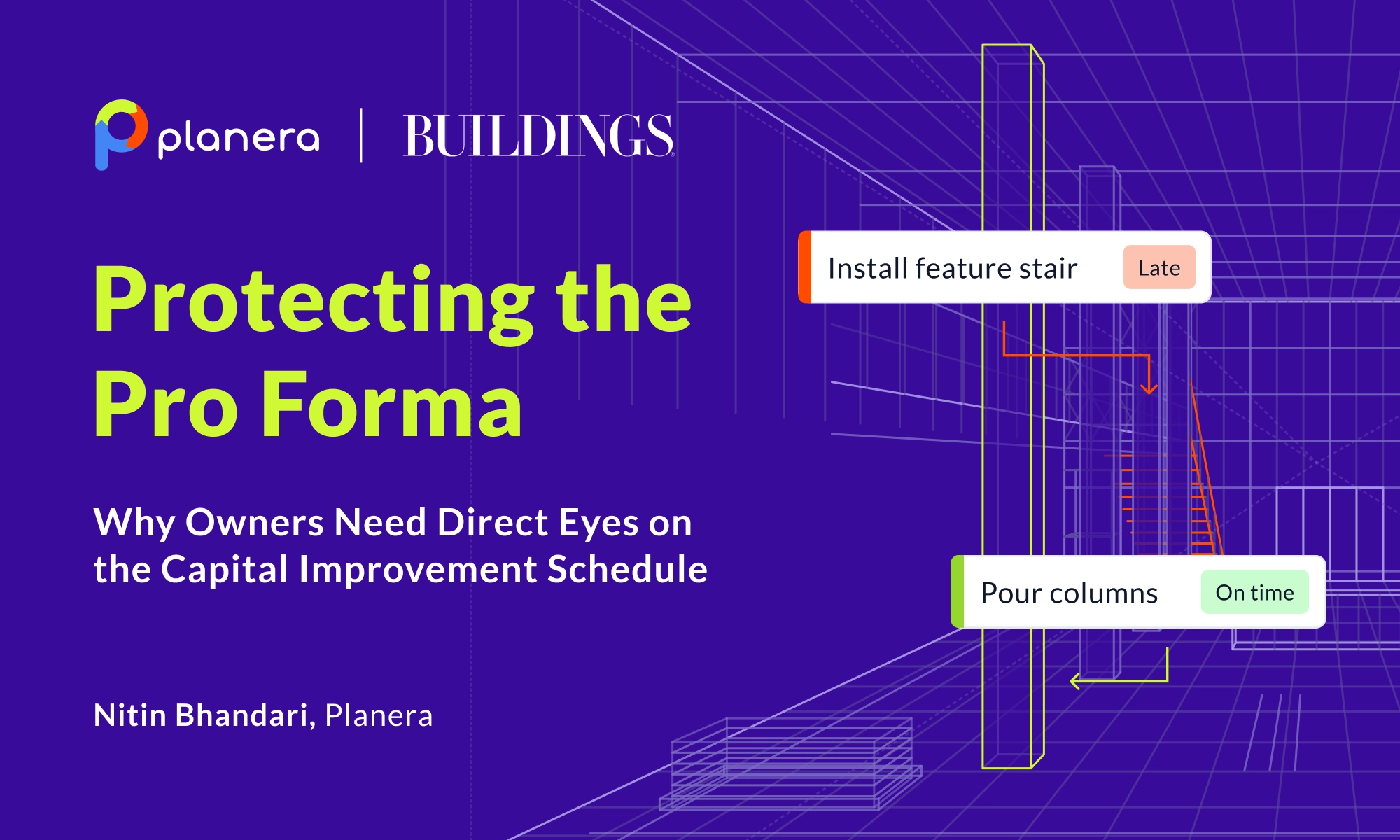
Capital improvement projects tend to run on the same type of schedule that's been used for years—and it's not built for the building owner to read. Here's why that needs to change.
Key Highlights
- Traditional schedules are designed for project managers, not owners, leading to delayed awareness of project delays.
- The information gap can cause significant financial impacts, including increased costs and delayed tenant occupancy.
- Modern tools like cloud-based platforms and AI can visualize dependencies clearly and stress-test schedule logic automatically.
- AI-driven schedule review helps identify optimistic assumptions and hidden risks before they become costly issues.
- Closing the visibility and validation gaps enables owners to receive real-time, reliable updates, reducing the risk of unrecoverable delays.
A Building Owner's Problem
A building owner is three months into a lobby renovation. The general contractor's monthly update says everything is on track. Four weeks later, the same GC calls to say the completion date has slipped six weeks—a finish package back-ordered, a permit resubmittal nobody flagged early. The owner didn't see it coming because there was nothing to see. The only view into the project was a status report built once a month, in a format designed for a scheduler, not for the person whose lease-up timeline just got wrecked.
This is not a rare failure mode. It's the default one.
A Structural Information Gap, Not A Bad Actor
Most capital improvement projects—HVAC replacements, roof overhauls, lobby and common-area renovations—run on the same information architecture they've run on for decades. The GC's scheduler maintains the master schedule, usually in Primavera P6, tracking logic ties, float, and critical path across hundreds of activities. The owner gets a monthly narrative and a Gantt chart snapshot. Nobody is hiding anything. The schedule itself just isn't built for the owner to read—it's a working tool for the scheduler, not a communication device for the person carrying the financial exposure.
That gap has a name in the forensic scheduling world: the difference between what the project team knows and what the owner sees, and how long it takes for the first to become the second. On a well-run project, that lag might be a few weeks. On a poorly run one, it's the whole reason the owner finds out about a delay only after it's already unrecoverable.
The Money Behind the Gap Is Real
McKinsey's research on capital project performance puts a number on what a single year of schedule slip is worth across a portfolio of projects: at a 10% discount rate, a one-year delay can cut net present value by close to half. That's portfolio-scale math, but the mechanism is identical at the scale of a single lobby renovation or HVAC overhaul: a slipping completion date doesn't just cost the difference between two calendar dates. It compounds—through financing costs that keep accruing, tenant move-ins that get pushed, and in the worst cases, lease provisions that let a tenant walk if occupancy is late enough.
None of that shows up in a monthly narrative until it's already happened. And by the time it shows up, the owner's options are down to the expensive ones—expedited freight, overtime crews, a hard conversation about who eats the holdover cost.
Why the Gantt Chart Doesn't Fix This
The instinct is to say: just give the owner the schedule. Most GCs will, if asked. The problem is what "the schedule" actually is. A CPM network with hundreds of activities, logic relationships, and float calculations is not something you hand to a facility manager and expect them to read cold. It requires training most owners don't have and shouldn't need. So the schedule gets summarized—which means someone decides what's worth telling the owner and what isn't, weeks after the fact.
That's the actual failure point. Not concealment. Translation lag.
What's Changing: Visual, Collaborative, and Increasingly AI-Enhanced
The scheduling tools built in the last several years attack that translation lag from a few different directions, and it's worth naming all of them. First, visual: cloud-based platforms present the same milestones and dependencies a scheduler sees, in a form that doesn't require CPM training to interpret. Second, collaborative: owner, GC, and subcontractors work off one live schedule instead of reconciling separate copies over email. Third, and less visible to the owner but arguably more important: AI that helps the GC's own scheduling team interrogate the schedule before it ever gets summarized for anyone else.
A CPM network with a few hundred activities has a lot of places to hide an optimistic assumption. A duration that's technically defensible but has never once been hit in the field. A sequence drawn as linear that doesn't need to be. A task tagged low-risk that keeps drifting toward the critical path every time the schedule gets updated. Catching these used to depend entirely on how much time a scheduler had to manually pressure-test the logic—which, on a real project with a real deadline, is usually not much. AI that can reason over the full dependency structure can flag exactly this kind of thing: which durations look inconsistent with how similar work has actually gone, which activities are quietly becoming critical, which parts of the logic deserve a second look before the schedule goes out the door.
The result isn't a schedule that merely looks more polished. It's a schedule that's been challenged—by the people who built it—before the owner ever sees it. That's a different kind of improvement than visibility alone. Visibility gets the owner a better window into the schedule. A scheduling team that's routinely stress-testing its own logic gives the owner a better schedule to look through that window at.
The Owner Doesn't Need to Become the Scheduler
To be clear about what this isn't: it isn't asking facility managers to learn Primavera, and it shouldn't be. Owners have their own jobs. What they need is a schedule that's both visible to them and been genuinely pressure-tested by the team that built it—not a polished narrative assembled once a month.
That's a different posture than trusting a GC's stated date at face value. It's closer to what owners already expect from every other part of running a building: real-time information about the things that affect their budget, built on a schedule that's actually been challenged, not just reported.
The Gap is the Risk
This isn't an argument for adopting new tools because tools are good. It's narrower than that: capital improvement schedules have historically lived in a format—and been produced under a review cadence—built for the person managing the work, not the person carrying the financial risk if the work runs late. Visual and collaborative scheduling closes the visibility half of that gap. AI-assisted schedule review closes the other half, by giving the GC's team a way to catch a bad assumption before it becomes next month's bad news. Together, they shrink the time between when a delay happens on site and when the owner learns about it—and improve the odds that what the owner is looking at was actually a good schedule to begin with.
For an owner holding a pro forma built around a specific completion date, that lag is the entire risk profile of the project. The question isn't whether a delay will happen. On a long enough project, one will. The question is how many weeks pass before the owner is the last to know, and how much scrutiny the schedule got before that clock started running.
Planera gives owners, GCs, and trade partners one live CPM schedule, with Manny pressure-testing the logic before it goes out. For more on AI schedule review, read what AI construction scheduling has to get right and our guide to delay analysis in construction. Or see it in a demo.

You deserve better scheduling software.
Drive revenue, reduce costs, and manage scheduling with Planera.
Request a Demo