



Construction project performance remains a major concern, with KPMG’s Global Construction Survey 2025/2026 showing that 75% of construction executives are more risk-averse than they were 12 months earlier. As projects become larger and more complex, AI scheduling tools can help teams analyse project data, identify potential delays earlier, and test different scheduling scenarios.
This guide covers six AI construction scheduling tools in 2026, their key features, use cases, and how they compare with traditional scheduling software.
What Is AI Construction Scheduling Software?
AI construction scheduling software uses technologies such as machine learning, simulation, computer vision, and natural language processing to build, analyse, monitor, or improve project schedules.
Traditional CPM in scheduling calculates dates, dependencies, and floats based on the logic entered by the scheduler. AI adds capabilities that can analyse project data, identify patterns, make predictions, and help teams test different scheduling options.
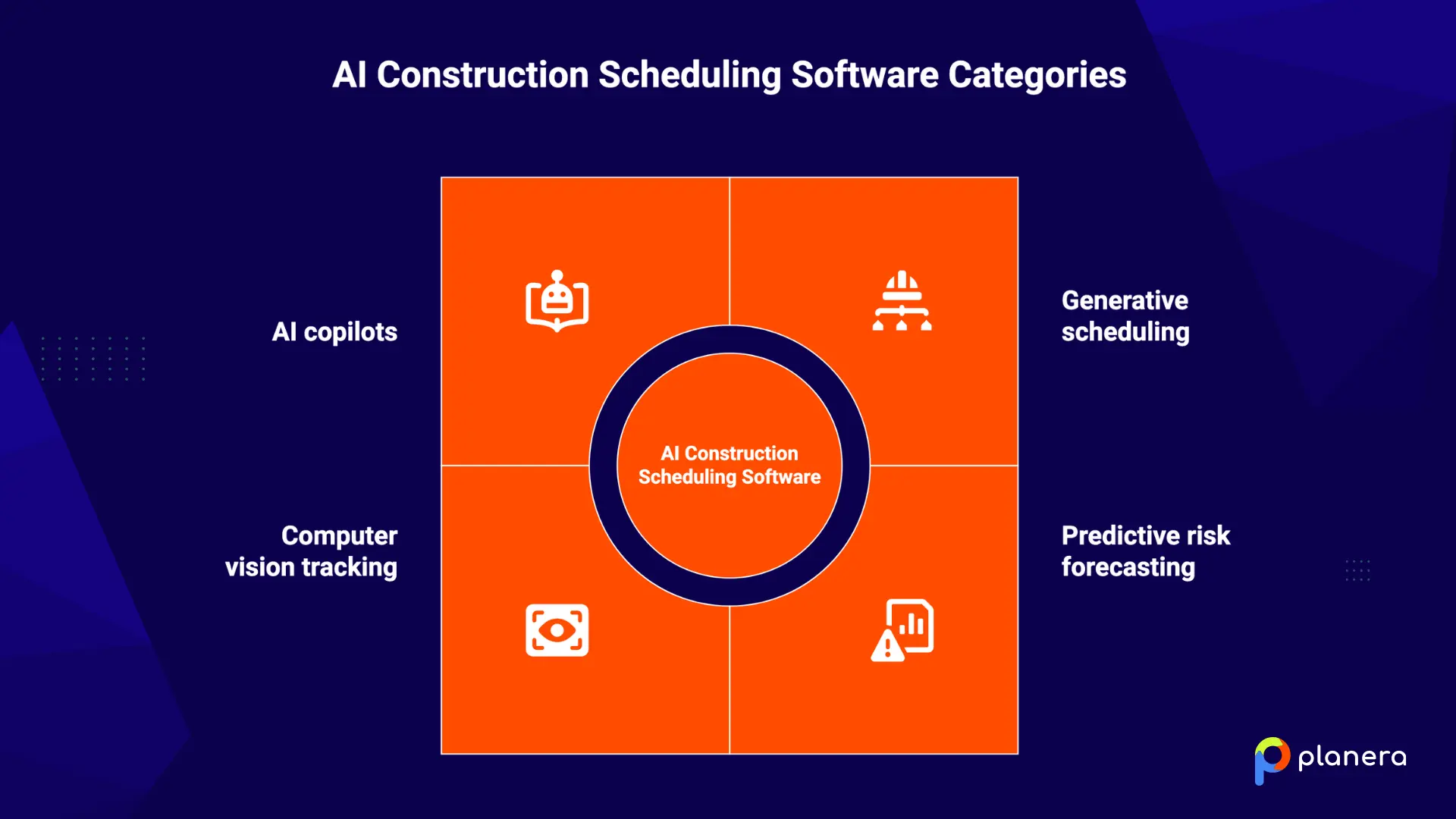
These tools generally fall into four categories:
- Generative scheduling and optimisation: Tests different construction sequence plans based on project constraints.
- Predictive risk forecasting: Uses historical and current project data to identify potential schedule risks and delays.
- Computer vision progress tracking: Compares site images or video with planned work to monitor progress.
- AI copilots: Let users ask questions about schedules and get assistance with analysis and scenario planning.
The AI in the construction market is projected to grow from $6.02 billion in 2026 to $35.53 billion by 2034. Project management, scheduling, and budgeting account for roughly 34% of that market.
What Are the Best AI Construction Scheduling Tools?
Each tool below solves a different part of the scheduling problem. Match the tool to your bottleneck, not the other way around.
| Tool | Best For | Core AI Capability | Ideal Project Type | Notable Feature |
|---|---|---|---|---|
| Planera | Visual, collaborative CPM scheduling | AI assistant for float, logic, and what-if questions | Commercial, healthcare, data centers, heavy civil | Manny AI assistant + CPM Canvas |
| InEight Schedule | AI-assisted capital construction scheduling | AI templates trained on your own schedule library | Large capital programs, energy, industrial | Look-ahead planning inside the master schedule |
| ALICE Technologies | Schedule optimization and what-if scenarios | Generative simulation of thousands of scenarios | Data centers, energy, transit, industrial | Schedule Insights Agent |
| nPlan | Schedule risk prediction | Deep learning trained on 750,000+ schedules | Large portfolios, infrastructure | Driving Paths and AI-SRA |
| Buildots | Progress tracking and delay forecasting | Computer vision aligned to BIM and schedule | Large, BIM-mature building projects | Delay Forecast with root-cause analysis |
| Microsoft Project | Traditional scheduling with AI help | Copilot WBS generation and status reports | General projects, Microsoft-standardized teams | Copilot sidecar chat |

1. Planera: Best for Visual and Collaborative Construction Scheduling
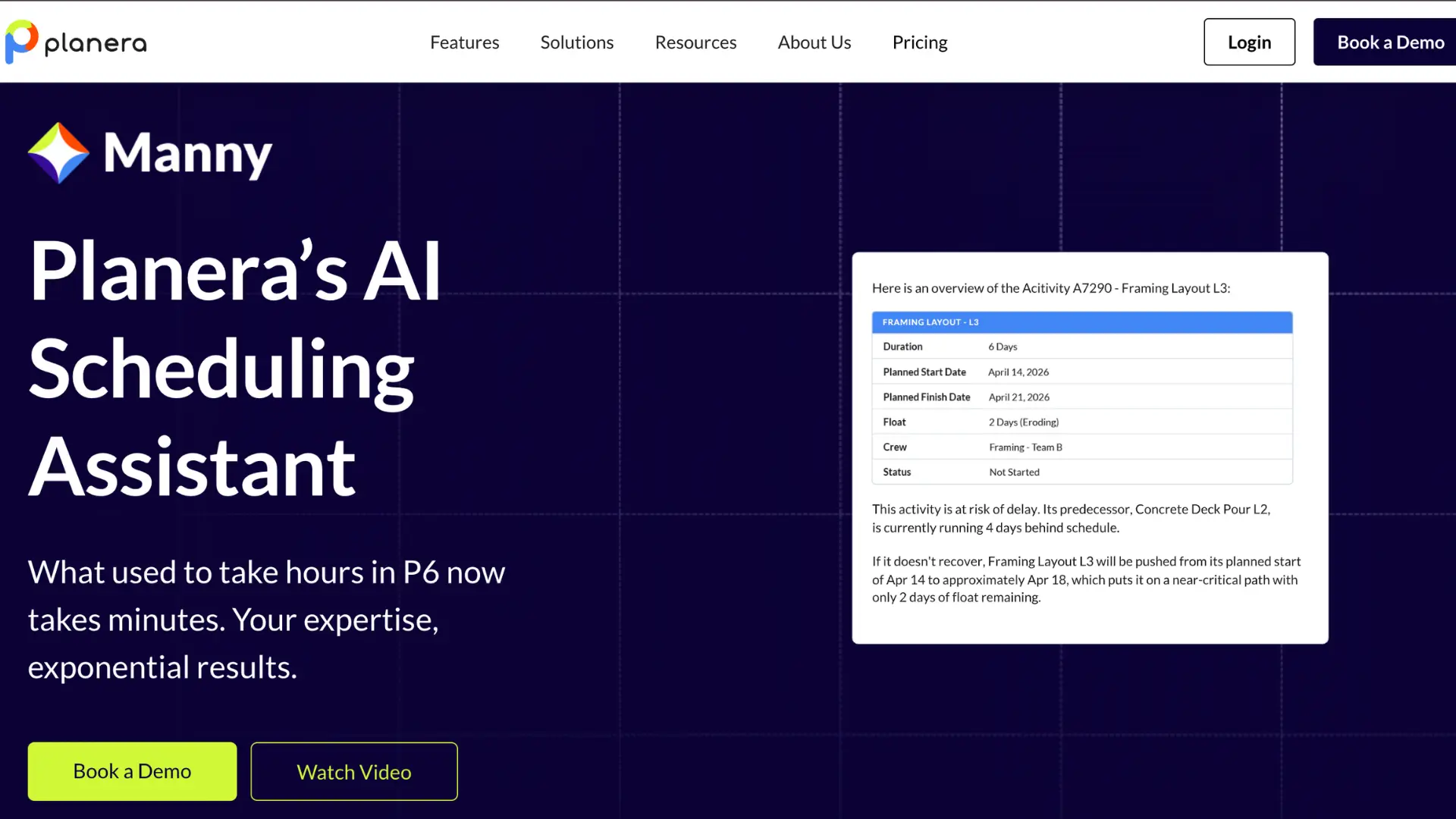
Planera is a visual, collaborative CPM scheduling platform built around a drag-and-drop CPM Canvas. Multiple team members can build, review, and update schedules together while keeping standard CPM logic, including relationships, lag and lead times, and constraints.
Planera's AI scheduling assistant Manny, works inside the live schedule. Teams can ask questions about float, logic ties, critical-path activities, and schedule risks in plain language. Manny can also help test what-if scenarios, making it easier to explore different sequencing and recovery options.
Other Planera features include:
- Collaborate on Whiteboard: Work on the same schedule with other team members and make updates together.
- Field Schedules: Turn the master schedule into more detailed plans that field teams can use for short-term work.
- Project Dashboard: View important project information and schedule metrics from a single dashboard.
- Risk Simulations: Test how different risks could affect the schedule and expected project completion date.
- DCMA Quality Check: Review a schedule for common quality and logic issues based on DCMA guidelines.
- Progress Updates: Record completed work and update the schedule as the project moves forward.
- Resource Loading: Add resources to activities to see where workloads may be unbalanced or create scheduling conflicts.
- Planera for iPad: Access and update project schedules from an iPad while working away from the office.
Best fit: GCs and project teams that want AI-assisted CPM scheduling, collaborative planning, and project controls in one platform.
2. InEight Schedule: Best for AI-Assisted Capital Construction Scheduling
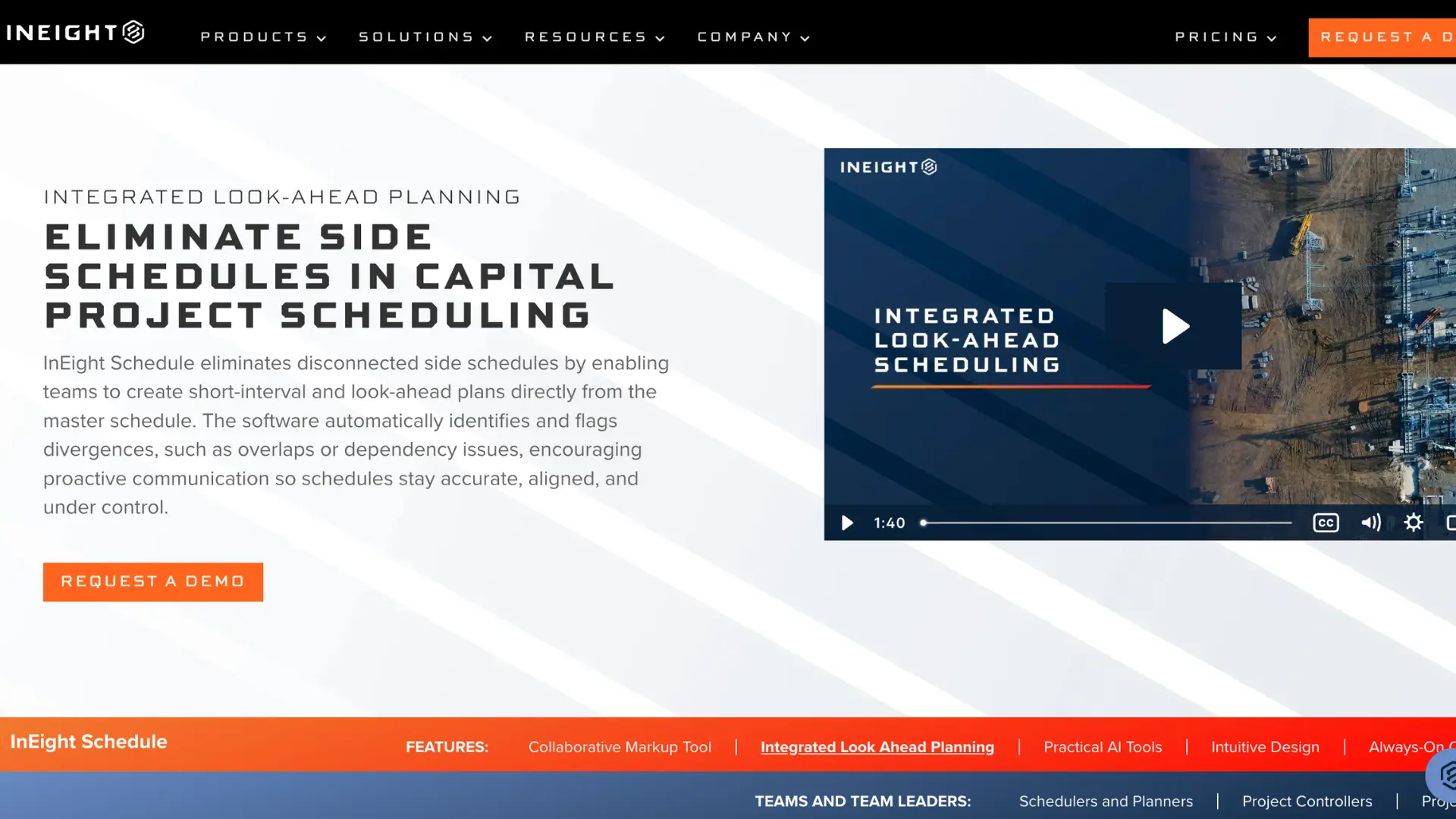
InEight Schedule is part of InEight’s broader project controls platform and focuses on scheduling for large capital construction projects. It combines CPM scheduling with collaborative planning, look-ahead schedules, AI-assisted analysis, and risk management.
Key features include:
- AI-assisted scheduling: Uses historical project schedules to help create draft schedules and develop plans from high-level work breakdown structures.
- Schedule recommendations: Suggests activity durations, sequencing, risks, and costs based on data from similar projects.
- Look-ahead planning: Connects short-term planning with the construction master schedule so field teams can work from the same project plan.
- Risk management: Models schedule uncertainty and provides insight into potential completion dates.
- Collaborative scheduling: Gives project and field teams a shared environment for reviewing and updating schedules.
- Accessible scheduling tools: Helps project managers and field teams work with schedules without needing advanced scheduling skills.
Best fit: Owners and contractors managing complex capital projects in infrastructure, energy, and industrial construction who need AI-assisted scheduling and risk analysis in one platform. Pricing is quote-based.
3. ALICE Technologies: Best for AI Schedule Optimization and What-If Scenarios
ALICE Technologies uses generative AI to create and compare different construction schedule options. Teams provide project constraints, dependencies, resources, and other requirements, and ALICE tests many possible schedules to find options that meet their goals.
Key features include:
- Schedule optimization: Tests thousands or more possible schedule combinations to find options that meet time, cost, and resource goals.
- What-if scenarios: Helps teams compare different ways to sequence work and see how changes could affect the project.
- Optimization objectives: Lets users set priorities such as shortening the schedule through approaches like construction fast tracking, reducing resource downtime, or meeting key milestones.
- Schedule Insights Agent: Lets teams ask questions about the schedule in plain language and identify factors that could affect project milestone schedules.
- Time and cost comparison: Shows different schedule options so teams can compare their potential time and cost impact. ALICE Technologies
- Shutdown and outage planning: Provides scheduling tools for shutdown, turnaround, and outage projects in industrial construction. Shutdown, Turnaround, and Outage Planning
Best fit: Large and complex projects, such as data centers, energy facilities, and transit infrastructure, where teams need to test many scheduling options before choosing a plan.
4. nPlan: Best for AI-Powered Schedule Risk Prediction
nPlan uses AI to analyze project schedules and predict where delays may occur. Its models are trained on more than 750,000 historical project schedules to estimate activity durations and identify areas that could put project milestones at risk.
Key features include:
- Schedule risk analysis: Uses historical schedule data to estimate the likelihood and potential impact of delays.
- Driving Paths: Shows which activities and parts of the schedule could have the biggest effect on key milestones.
- Early risk detection: Can identify risks that may not appear on the traditional critical path but could still affect the project.
- Schedule Studio: Helps teams create new schedule plans using plain-language inputs.
- Insights: Provides AI-based analysis to help project teams understand schedule risks and trends.
- AutoReport: Automates schedule reporting and presents key findings in a more accessible format.
- Schedule Integrity Checker: Reviews schedules for issues that could affect the quality of risk analysis.
- Integration with existing tools: Can work alongside platforms such as Procore and Primavera rather than replacing them.
Best fit: Risk managers and project controls teams managing large project portfolios that need data-based schedule risk analysis. The quality of its predictions also depends on having accurate and consistent schedule data.
5. Buildots: Best for AI-Powered Progress Tracking and Delay Forecasting
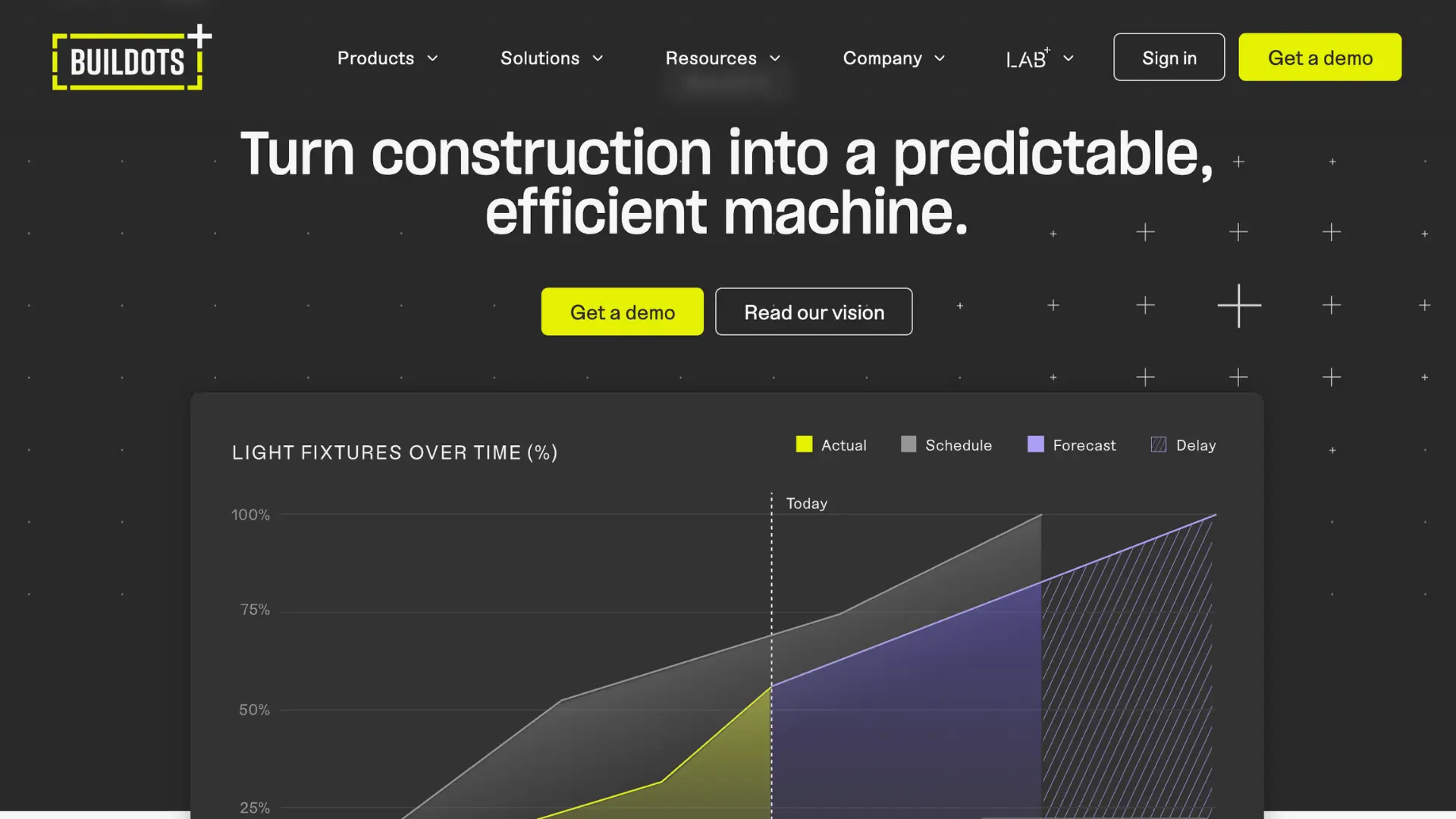
Buildots uses computer vision to track construction progress and compare actual work with the BIM model and project schedule. Site teams capture 360-degree footage while walking the jobsite, which Buildots then analyses to show how much work has been completed and where progress may be falling behind.
Key features include:
- 360-degree site capture: Uses hardhat-mounted cameras to collect regular footage from the job site.
- Progress tracking: Compares site footage with the BIM model to track completed work at the individual element level.
- Delay Forecast: Compares planned and actual work rates to identify activities that could fall behind schedule.
- Early delay warnings: Flags activities at risk of missing their planned dates before the delay becomes clear in the main schedule.
- Root-cause analysis: Helps teams identify which trades, locations, or time periods are linked to slower progress.
- What-if analysis: Lets users test different work-rate assumptions, such as adding labour or changing the sequence of work.
Best fit: Large projects with established BIM workflows and regular site data collection. It may be less practical for smaller projects or teams without the systems needed for regular digital progress tracking.
6. Microsoft Project: Best for Traditional Construction Scheduling With AI Assistance

Microsoft Project is a traditional project scheduling tool that now includes AI features through Microsoft Copilot. This makes it an option for teams that already use Microsoft products and want to add AI support without moving to a new scheduling platform.
Key features include:
- AI-assisted planning: Copilot for Project can create a preliminary work breakdown structure from a project description.
- Natural-language assistance: Users can interact with project information and request help using plain-language prompts.
- Risk analysis: AI can identify potential project risks and suggest ways to address them.
- Automated reporting: Generates project status reports using schedule and financial information.
- Resource and schedule planning: Uses project dependencies, resources, and other project data to support scheduling and updates.
- Microsoft integration: Works with other Microsoft tools, including Teams and Planner, and can connect project, cost, and resource information across the Microsoft ecosystem.
Best fit: Construction teams already using Microsoft 365 that want to add AI features to their existing project scheduling workflow. It has fewer construction-specific capabilities than tools built around BIM progress tracking or advanced schedule optimization.
How Do AI Construction Scheduling Tools Work?
AI construction scheduling tools use project data to analyze schedules, identify risks, and help teams evaluate possible changes. The exact process varies by software, but it generally includes these steps:
- Collect and prepare project data. The software uses information such as activities, dependencies, durations, resources, constraints, and progress updates. Some tools can also use historical project data to improve their predictions.
- Analyze the schedule. AI looks for patterns and relationships in the schedule that could affect the planned sequence or completion date. This can include changes in activity durations, dependencies, resource availability, and progress.
- Identify schedule risks. The software estimates which activities or parts of the schedule could lead to delays. More advanced tools can also estimate the probability and potential impact of different outcomes.
- Test different scenarios. AI can evaluate alternative sequences, resources, or activity durations to show how changes could affect the project schedule. This lets teams compare options before making changes to the live schedule.
- Compare planned and actual progress. When connected to project updates or site data, AI can compare planned work with actual progress and highlight areas where the project is falling behind.
- Support schedule decisions. The final output can include risk alerts, schedule recommendations, forecasts, or scenario comparisons. The scheduler still reviews these results and decides which changes, if any, to make.
What Features Should You Look for in AI Construction Scheduling Software?
When comparing AI construction scheduling software, focus on the features that match your project size, scheduling process, and team needs. Important features include:
- AI schedule analysis: Look for tools that can analyze schedule logic, identify potential issues, and explain factors that may affect the project timeline.
- Delay prediction and risk analysis: The software should help identify activities that could cause delays and show how different risks may affect the completion date.
- Resource and cost planning: Resource and cost loading can help teams see how labour, equipment, and other resources affect the schedule.
- Automated schedule updates: Tools that connect progress data to the schedule can reduce manual updates and keep planned and actual progress aligned.
- Progress tracking: Look for baseline comparisons, schedule variance information, and clear visibility into where work is ahead or behind plan.
- Visual scheduling: A visual schedule can make complex plans easier for project managers, superintendents, and field teams to review and understand.
- Collaboration: Multiple users should be able to review, update, and share schedule information without relying on separate files and manual exchanges.
- Software integrations: Check whether the tool works with the systems your team already uses, such as Primavera P6, Microsoft Project, Procore, or Autodesk Construction Cloud.
What Are the Benefits of AI Construction Scheduling Tools?
AI construction scheduling tools can help teams analyze schedules faster, identify risks earlier, and compare different planning options. The main benefits include:
- Earlier risk detection: AI can analyze schedule data to identify activities and dependencies that may contribute to delays, giving teams more time to respond.
- Better schedule planning: Teams can test different sequences, resources, and durations before making changes to the project schedule.
- Less manual work: Automated schedule analysis, reporting, and progress updates can reduce repetitive work for schedulers and project teams.
- Improved resource planning: AI can help teams identify resource conflicts and understand how changes in labour or equipment availability could affect the schedule.
- More accurate forecasting: Predictive models can use historical and current project data to estimate potential completion dates and schedule risks.
- Faster decision-making: Instead of reviewing large amounts of schedule data manually, teams can use AI-generated insights to focus on activities and risks that need attention.
A Bridgit survey found that 46% of construction companies using AI saved between 500 and 1,000 hours, showing the potential for AI to reduce time spent on repetitive work. Actual results will vary depending on the software, project data, and how the tool is used.
What Are the Limitations of AI Construction Scheduling Tools?
AI can improve schedule analysis and forecasting, but it also has limitations. Before choosing a tool, consider the following:
- Data quality matters: AI predictions depend on the project data behind them. Inconsistent or incomplete schedules can lead to less reliable results.
- Some tools require additional technology: Computer-vision scheduling tools may require BIM models, regular site capture, and suitable camera coverage. This can make them harder to use on smaller or less digitized projects.
- Costs can be high: Some enterprise AI scheduling platforms have significant licensing and implementation costs. Pricing varies widely, so teams should compare the expected benefits with the total cost of adoption.
- Results vary by project: AI performance depends on the type and quality of data available, the project environment, and how the software is implemented. Vendor case studies may not reflect results on every project.
- Human review is still important: AI can identify patterns, forecast risks, and compare scenarios, but schedulers still need to consider factors that may not appear in the data, such as subcontractor performance, site conditions, and supply issues.
For this reason, it is useful to test an AI scheduling tool on a real project before rolling it out across the company. This gives teams a chance to compare the software's results with their existing scheduling process.
AI Construction Scheduling Software vs Traditional Scheduling Methods
Traditional CPM software remains useful for creating and managing construction schedules. AI tools add capabilities such as predictive analysis, scenario testing, and automated insights. The main differences are in how teams analyse information and respond to schedule changes.
| Area | Traditional Scheduling | AI Construction Scheduling |
|---|---|---|
| Schedule analysis | Relies mainly on manual review by schedulers. | Analyses schedule data and highlights potential issues. |
| Risk detection | Risks are identified through schedule updates and manual analysis. | Uses data to identify patterns that may indicate future delays. |
| What-if scenarios | Scenarios are created and compared manually. | Tests multiple scenarios and compares their potential impact. |
| Progress tracking | Progress is often entered and compared with the baseline manually. | Some tools connect schedule data with field or site information. |
| Decision-making | Schedulers perform the analysis and make the final decisions. | AI provides forecasts and recommendations, while schedulers review and act on them. |
The two approaches can also work together. Many construction teams still use traditional CPM platforms for contract requirements and detailed schedule management while adding AI tools for risk analysis, forecasting, or scenario planning. Some teams also combine these with collaborative approaches like pull planning in construction to keep field teams aligned with the overall project plan.
Final Thoughts
The right AI scheduling tool depends on what your team needs from it. Some platforms focus on schedule optimisation and what-if analysis, while others are built around risk forecasting, progress tracking, or adding AI capabilities to existing scheduling software.
Before choosing a platform, consider the size and complexity of your projects, the quality of your schedule data, the systems you already use, and how much automation your team actually needs. It is also worth testing a tool with a real project before rolling it out more widely.
For teams looking for a visual and collaborative approach to CPM scheduling, Planera combines AI-assisted analysis with scheduling, risk management, field planning, and schedule quality tools in one platform. Book a Planera demo to see how it can fit your team's scheduling workflow.
FAQ
What is the best AI construction scheduling software?
There is no single option for every construction team. Planera focuses on visual and collaborative CPM scheduling, ALICE on schedule optimization and scenario planning, nPlan on schedule risk, and Buildots on progress tracking. InEight focuses on capital construction, while Microsoft Project adds AI features to a familiar scheduling platform.
How does AI help with construction scheduling?
AI can analyze project data, identify potential schedule risks, compare different scenarios, and support progress tracking. This can reduce manual analysis and help teams respond to potential problems earlier.
Can AI predict construction project delays?
Yes. Some AI tools use historical and current project data to estimate which activities or milestones may be at risk. The accuracy of these predictions depends on the quality and amount of data available.
Can AI create a construction schedule?
Some tools can generate draft schedules or suggest activities, durations, and sequences. A scheduler should still review the results and adjust them based on project requirements and site conditions.
How accurate are AI construction scheduling tools?
Accuracy depends on the software, the data it uses, and the project. Incomplete or inconsistent schedule data can lead to less reliable predictions. Testing a tool on a real project can help teams understand how well it performs for their needs.
What data does AI construction scheduling software need?
Most tools need schedule information such as activities, durations, dependencies, resources, and progress data. Some systems can also use historical project schedules, while computer-vision tools may require BIM models and site imagery.
Can AI construction scheduling tools replace project schedulers?
No. AI can support schedule analysis, forecasting, and scenario planning, but schedulers still need to review the results and apply project-specific knowledge and judgment.
How much does AI construction scheduling software cost?
Pricing varies significantly between platforms. It can depend on factors such as the number of users, projects, features, implementation requirements, and the type of AI technology involved. Check with each provider for current pricing.

You deserve better scheduling software.
Drive revenue, reduce costs, and manage scheduling with Planera.
Request a Demo