



How long does it take to build a data center? There is no single answer. A project can take less than two years or stretch beyond six, depending on its size, power requirements, site conditions, permitting, and the complexity of the design.
The timeline also involves more than construction. Power availability, equipment lead times, design coordination, and commissioning can all affect when a facility is ready for operation.
This guide breaks down the data center construction timeline by phase, explains what can extend the schedule, and looks at how teams can use CPM scheduling to plan and manage these complex projects more effectively.
How Long Does Data Center Construction Take?
A large data center project can take three to six years from site selection through commissioning. Vertical construction itself can take roughly 12 to 36 months, depending on the size and complexity of the facility.
The timeline changes significantly depending on the type of project. After the site and utility supply are secured, some hyperscale facilities can move from planning into deployment within 18 to 24 months. Larger campus developments follow a different model, with construction and expansion continuing for many years as new capacity is added.
Power capacity is another major factor. A smaller 5 MW facility and a 200 MW campus may have very different electrical infrastructure, equipment requirements, and utility coordination needs. As a result, project duration does not always increase in direct proportion to building size.
For construction project managers, the challenge is keeping all these moving parts aligned. A data center schedule may need to coordinate:
- Design and engineering
- Permitting and utility work
- Long-lead equipment procurement
- Structural and MEP work
- Electrical and mechanical systems
- Testing and commissioning
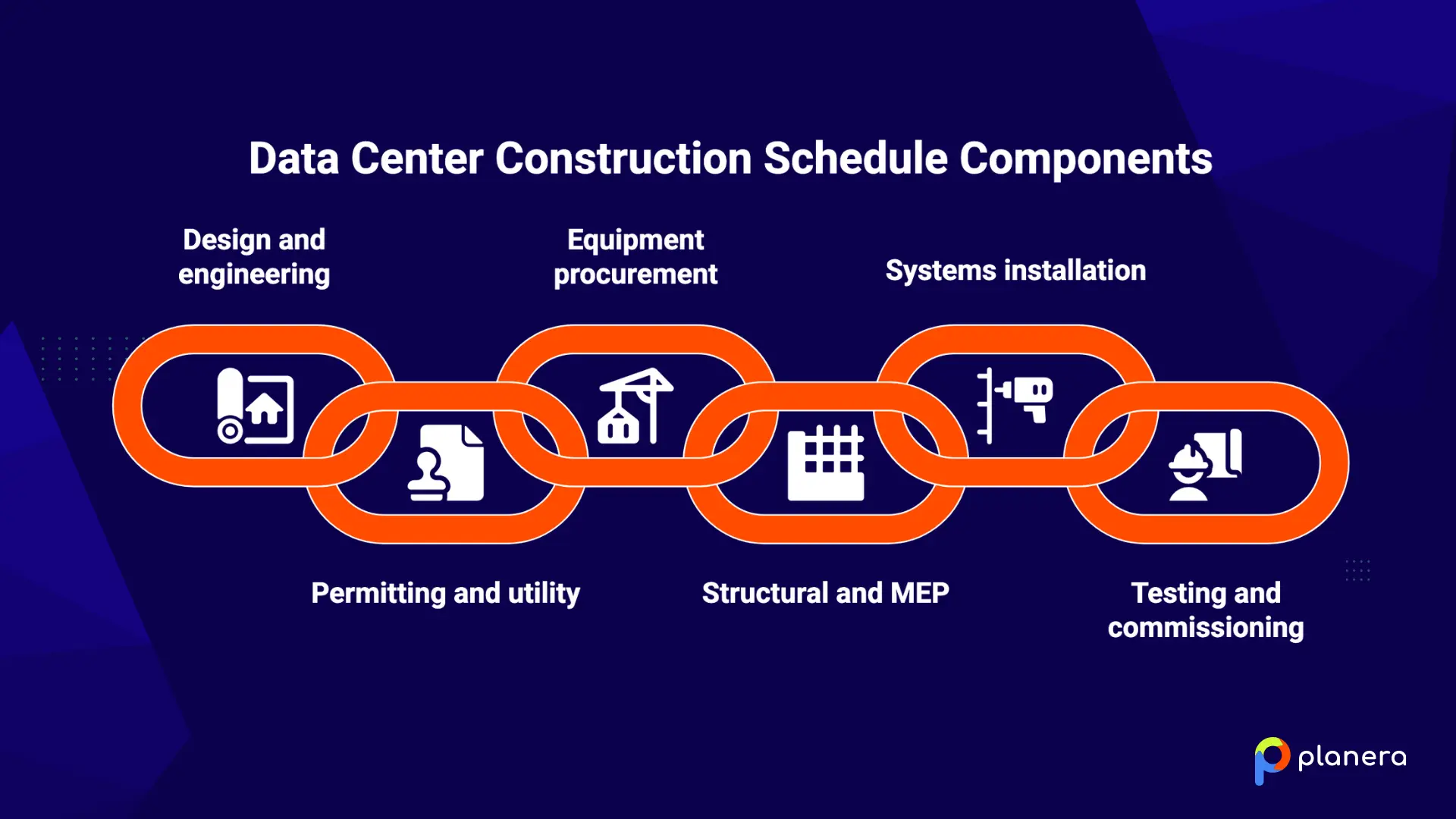
These activities are closely connected. A delay in equipment delivery, for example, can affect installation, testing, and commissioning dates further down the schedule.
That is why data center construction requires more than a target completion date. Teams need a detailed construction schedule that shows dependencies, identifies the critical path, and makes it easier to adjust the plan when conditions change.
For this reason, it is more useful to think of the data center construction timeline as a series of connected phases rather than one fixed number.
How Long Does Each Phase of Data Center Construction Take?
Data center construction does not follow one fixed sequence. Several phases overlap, and some can continue while other work is already underway.
The ranges below combine estimates from iRecruit, Broadstaff, and Smartbarrel.
| Phase | Typical Duration |
|---|---|
| Site Selection and Feasibility | 3 to 6 months |
| Design and Engineering | 6 to 12 months |
| Permitting and Approvals | 6 to 18 months |
| Site Preparation and Groundwork | 2 to 4 months |
| Structural Construction | 6 to 12 months |
| Electrical and Mechanical Installation | 6 to 12 months |
| Data Center Fit-Out | 3 to 6 months |
| Testing and Commissioning | 3 to 6 months |
| Final Handover and Operational Readiness | 1 to 2 months |

These durations should not be added together. On a real project, design, permitting, procurement, site work, and construction often overlap.
Site Selection and Feasibility
Teams evaluate grid access, fiber routes, land, water availability, and environmental constraints. Broadstaff estimates this phase at 3 to 6 months.
Utility availability can have a much larger effect on the overall schedule. According to iRecruit, interconnection studies are among the major bottlenecks for data center projects, with some taking years to complete.
Design and Engineering
This phase covers architectural, structural, electrical, and mechanical design. It also provides an opportunity to identify long-lead equipment and begin procurement planning.
Larger projects can spend 9 to 18 months on design and development. Because later construction activities depend on design decisions, changes at this stage can affect procurement, installation, and commissioning dates.
Permitting and Approvals
Permitting can include zoning, environmental, utility, and building approvals. The duration varies significantly by location and project.
PJM data presented in January 2026 showed that permitting accounted for 29% of milestone change requests for projects under construction or in development.
Since approval timelines can be difficult to predict, project schedules should account for potential changes rather than assuming a fixed approval date.
Site Preparation and Groundwork
Once the site is ready, crews can clear and grade the land, install underground utilities and duct banks, and prepare foundations.
This work needs to stay aligned with the electrical and mechanical design. For example, the location of generator and transformer pads affects later equipment installation and utility connections.
Structural Construction
Structural work includes the building shell, floors, roof, and other load-bearing elements.
The structure must support heavy equipment such as UPS systems, generators, and cooling equipment. Design changes during construction can therefore affect steel, concrete, equipment locations, and other connected activities.
Electrical and Mechanical Installation
This phase covers major systems such as switchgear, generators, UPS systems, busway, chillers, and controls.
Equipment lead times can have a major effect on the schedule. A Q2 2025 Wood Mackenzie survey reported an average lead time of 128 weeks for large transformers, while some substation transformers exceeded 160 weeks in 2026.
These lead times make procurement planning and schedule tracking particularly important for critical equipment.
Data Center Fit-Out
Fit-out brings systems and equipment into the data hall, including racks, containment, structured cabling, fire suppression, and security systems.
This work can overlap with late-stage MEP installation. Careful sequencing helps prevent different trades from competing for the same space and allows work to progress through different areas of the facility in a controlled order.
Testing and Commissioning
Commissioning moves from individual equipment and factory tests to integrated systems testing. Electrical, cooling, controls, and other systems are tested together to confirm that the facility performs as intended.
Problems discovered during commissioning can require work to be repeated or equipment to be adjusted, making this an important stage for schedule planning. Phased turnover can also allow parts of a large facility to become operational before the entire campus is complete.
Final Handover and Operational Readiness
The final phase includes delivering as-built documentation, O&M manuals, training staff, and transferring the facility to the operations team.
Handover is part of the project schedule, not just an administrative step. Operations teams need the right documentation, training, and systems knowledge before the facility can be fully brought into service.
What Makes Data Center Construction Different From Other Construction Projects?
Data center projects have several characteristics that make planning and scheduling more complex than typical commercial construction.
- High electrical load and utility requirements: Data centers can require utility-scale power, new substations, or major grid connections. Utility interconnection can become a critical schedule dependency that the construction team does not fully control.
- Complex mechanical and electrical systems: Electrical, cooling, and control systems must work together as one integrated facility. Changes to one system can affect several other activities and trades.
- Strict reliability and redundancy requirements: N+1 and 2N designs require additional equipment, installation work, and testing. These systems also create more dependencies to manage during construction.
- Extensive testing and commissioning: Data centers require multiple stages of testing, from equipment checks to integrated systems testing. Commissioning is a major project phase rather than simply a closeout task.
- Pressure to meet aggressive delivery schedules: Demand for new data center capacity puts pressure on teams to complete projects quickly. Kaizen estimates that a stalled 60 MW facility could represent about $14.2 million in lost value per month.
What Can Delay a Data Center Construction Timeline?
Several factors can push a data center project beyond its planned completion date. The most common include:
- Permitting bottlenecks: Permitting accounted for 29% of PJM milestone change requests in data presented in January 2026. Delays to approvals can push back site work and other activities that depend on them.
- Transformer and switchgear lead times: Long equipment lead times can delay electrical installation and commissioning. Wood Mackenzie data puts large transformer lead times at 128 weeks on average, with some substation transformers exceeding 160 weeks, while Introl reports 45 to 80 weeks for standard switchgear.
- Supply chain delays: Equipment and material delays can affect several connected activities. More than half of data center projects faced delays in 2025.
- Fiber supply and pricing: Fiber availability and pricing can create additional procurement pressure. Introl reports that optical fiber prices increased by more than 70% between December 2025 and January 2026, while quote validity fell to seven days.
- Cascading schedule delays: A delay in one activity can affect several others. A late permit can push procurement, a delayed transformer can change installation sequences, and a compressed construction period can leave less time for commissioning.
- Labor shortages: Data centers require specialized workers for electrical installation, QA/QC, commissioning, and other technical work. Difficulty finding the right personnel can delay testing, turnover, and other critical milestones.
How Do Electrical Load and Cooling Requirements Affect the Data Center Timeline?
Higher rack densities mean data centers need more power and more advanced cooling systems. Average rack density increased from about 16 kW in 2025 to 27 kW in 2026, while some newer AI systems can reach up to 246 kW per rack.
This affects more than the electrical design. Changes in hardware requirements can also affect:
- Electrical distribution and equipment
- Cooling systems and piping
- Equipment procurement
- Installation sequencing
- Testing and commissioning
Liquid cooling adds further requirements, including piping, coolant distribution units, leak detection, and additional testing. A mix of liquid and air cooling is common in current data center designs, with liquid cooling becoming more important as rack power increases.
For construction teams, the main concern is coordination. Changes to power or cooling requirements can affect procurement, installation, and commissioning, making early planning and schedule updates especially important.
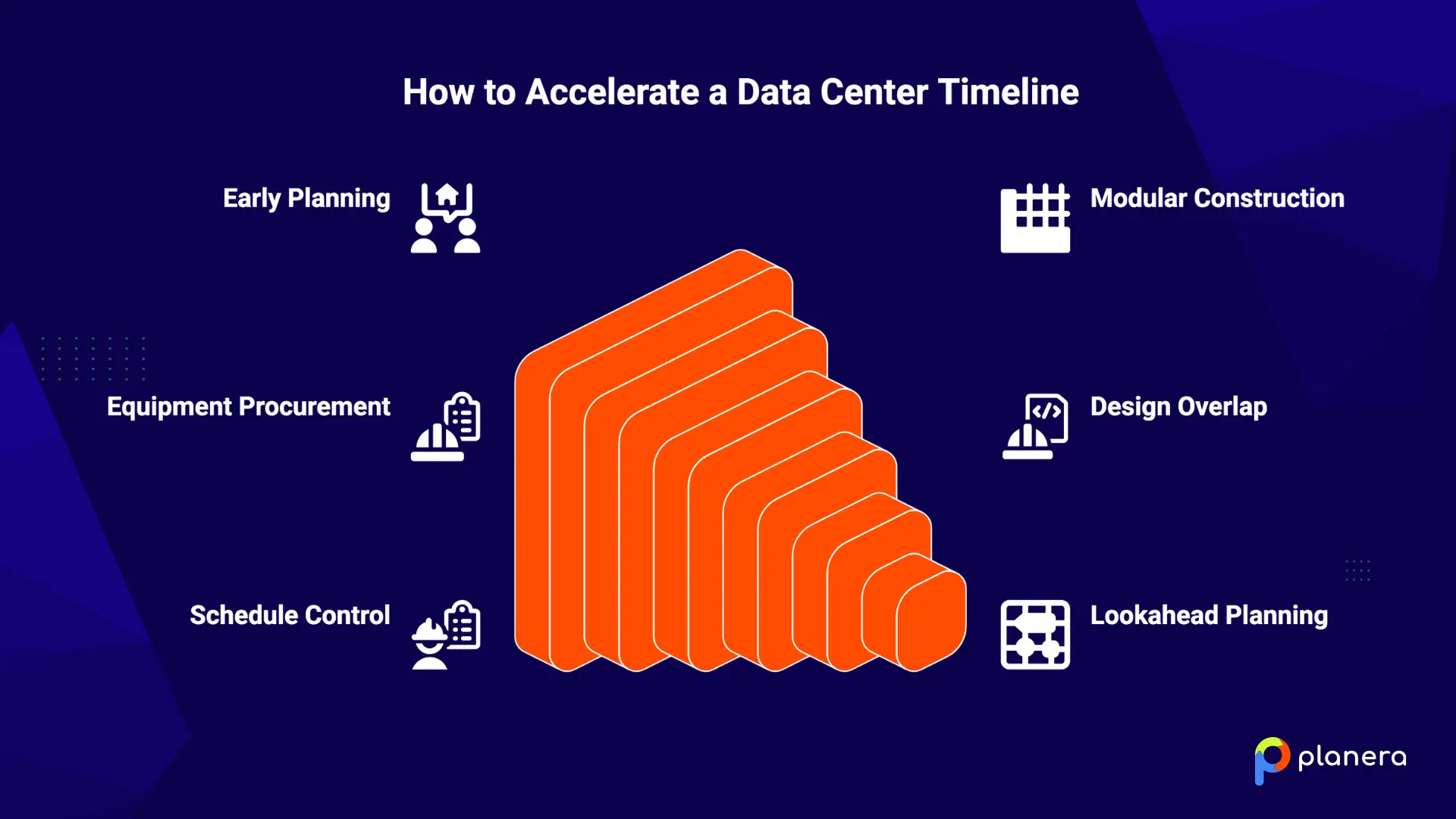
How Can Construction Teams Accelerate a Data Center Timeline?
Teams can reduce avoidable delays by focusing on early planning, procurement, and schedule control:
- Start site and utility planning early: Begin utility discussions and interconnection studies as early as possible.
- Use modular and prefabricated construction: Off-site fabrication can allow some work to happen in parallel with site preparation and reduce on-site construction time.
- Order long-lead equipment early: Include transformers, switchgear, generators, and other critical equipment directly in the project schedule.
- Overlap design and construction: Construction fast tracking can allow early construction packages to begin before the full design is complete.
- Maintain a detailed CPM schedule: Link procurement, construction, testing, and commissioning activities so teams can see how delays affect the completion date.
- Use lookahead planning: A 3 to 6 week lookahead helps teams identify upcoming constraints before they affect scheduled work. Pull planning in construction is one way to build these lookahead schedules collaboratively with trade teams.
How Can You Keep a Data Center Construction Timeline on Track?
Keeping a data center project on schedule comes down to visibility, coordination, and early action:
- Use one integrated schedule: Bring owner, GC, EPC, utility, procurement, and commissioning milestones into one schedule.
- Give teams shared visibility: Keep office and field teams working from the same current schedule and progress information.
- Track risks with the schedule: Review major risks alongside the critical path so teams can address potential problems before they affect key milestone schedule dates.
- Plan the workforce early: Schedule commissioning, QA/QC, and other specialist roles alongside equipment and material requirements.
The goal is not to eliminate every delay. It is to identify changes early, understand their impact, and adjust the schedule before they become larger problems.
How Planera Helps Manage the Data Center Construction Timeline
Planera gives data center teams a visual, collaborative way to manage complex CPM schedules. Teams can build and update schedules on a shared canvas, giving project managers, superintendents, and field teams a common view of the plan.
For data center projects, Planera supports:
- CPM scheduling and float analysis to manage dependencies across procurement, construction, and commissioning
- Field and construction master schedule coordination for more connected lookahead planning
- Monte Carlo analysis to assess how schedule risks could affect completion dates
- DCMA 14-Point checks to identify schedule quality issues
- P6 and Microsoft Project import/export for working with existing schedules
- Procore and Autodesk Construction Cloud integrations to connect scheduling with other project systems
The goal is to give teams a clear view of what is happening, what is coming next, and where schedule risks could affect the delivery date.
Open a Planera demo to see how it can support your next data center construction schedule.
FAQ
How long does it take to build a data center?
A full data center project typically takes three to six years from site selection through commissioning. Vertical construction can take roughly 12 to 36 months, depending on the project's size and complexity.
What is the longest phase of data center construction?
The construction phase, including structural, electrical, and mechanical work, can take the longest. However, permitting, utility work, and equipment procurement can also become the schedule's longest constraints.
What factors affect the data center construction timeline?
Key factors include power availability, utility work, permitting, equipment lead times, cooling requirements, labor availability, and site conditions.
How long does data center commissioning take?
Commissioning typically takes about 3 to 6 months. It includes equipment testing and integrated systems testing to confirm that the facility operates as intended.
What can delay a data center construction project?
Common causes include permitting delays, long equipment lead times, supply chain problems, labor shortages, and changes to the electrical or cooling design. Delays in one phase can also affect several downstream activities.
Can modular construction reduce data center construction time?
It can. Prefabricated and modular construction allows some components to be manufactured off-site while site work continues. The potential time savings depend on the project, design, and level of prefabrication.
How can you shorten a data center construction timeline?
Start utility planning and procurement early, use prefabrication where appropriate, and overlap design and construction when possible. A detailed CPM schedule can also help teams identify dependencies and manage delays.
What is the critical path in data center construction?
The critical path is the longest chain of dependent activities that determines the planned completion date. On a data center project, it can include activities such as equipment procurement, installation, energization, testing, and commissioning.
How do you keep a data center construction project on schedule?
Use an integrated schedule, review the critical path regularly, and use lookahead planning to identify upcoming constraints. Tracking risks and progress in the same schedule also helps teams respond to problems earlier.

You deserve better scheduling software.
Drive revenue, reduce costs, and manage scheduling with Planera.
Request a Demo