




A construction team can start the week with a clear list of commitments and still finish with several unfinished tasks. Percent Plan Complete (PPC) gives teams a simple way to measure how reliably those weekly commitments are being completed.
PPC is the percentage of planned tasks that crews finish as promised during a given week. It is commonly used as part of the Last Planner System, a lean construction approach that involves the people doing the work in planning and committing to upcoming tasks.
This guide explains the PPC formula, walks through an example, shows how to interpret the result, and covers common reasons for a low score and ways to improve it.
What Is Percent Plan Complete in Construction?
PPC is a weekly reliability metric used in the Last Planner System. It compares the tasks a team committed to complete with the tasks it actually completed. The Lean Construction Institute describes PPC as a basic measure of how well the planning system is working.
PPC uses a simple yes-or-no measure. A task is either complete or incomplete, with no partial credit. If a task is 90% complete at the end of the week, it still counts as incomplete.
PPC measures planning reliability, not how much physical work has been completed on the project. It is also a lagging indicator because it shows what happened during the previous week. Teams can pair it with a constraint log to identify problems before they affect planned work.
The weekly cycle is straightforward: the team commits to work at the start of the week, tracks progress, and reviews which commitments were completed at the end.
How Do You Calculate Percent Plan Complete in Construction?
The PPC calculation is simple. What matters is making sure the tasks included in the calculation are clearly defined and were part of the original weekly commitment.
Percent Plan Complete Formula
PPC = Completed Planned Tasks ÷ Total Planned Tasks × 100
Divide the number of planned tasks completed by the total number of tasks committed to for the week, then multiply by 100. If a team commits to 20 tasks and completes 15, its PPC is 75%.
What Counts as a Completed Task?
A completed task is one the crew finishes in full, to the agreed standard, within the committed week. A task that is only partly complete counts as incomplete.
Review each task at the end of the week with the foremen responsible for the work. Do not add new tasks during the week just to increase the PPC score. Doing so makes the number less useful and hides how well the original plan performed.
What Counts as a Planned Task?
A planned task is a specific assignment that a named foreman or crew commits to complete during the week. It should be ready to start, with key constraints such as materials, drawings, access, and predecessor work addressed.
Tasks should also be sized to the crew's actual capacity. A planned task is a realistic weekly commitment, not a general item from the construction master schedule or an unconfirmed backlog item.
When Should PPC Be Calculated?
Calculate PPC at the end of each week during the weekly review. Daily check-ins can track progress during the week, but the final PPC compares the original weekly commitments with what was actually completed.
Track the score week over week rather than focusing on one result. The trend can show whether planning reliability is improving and where recurring problems are affecting commitments.
What Is an Example of Percent Plan Complete in Construction?
Consider a GC managing a fit-out on the sixth floor of a mid-rise office building. On Monday, the foremen commit to 12 tasks. By Friday, they complete 9.
9 ÷ 12 × 100 = 75% PPC
Three tasks were not completed:
- Ceiling grid, east wing: An RFI about soffit heights was still awaiting an answer.
- Restroom tile: The tile delivery was delayed by two days.
- Corridor drywall hang: The sprinkler crew had not released the area.
During the weekly review, the team records the reasons and assigns owners to address them. The PM follows up on the RFI, while the superintendent confirms material deliveries in advance. The following week, the team commits to 12 tasks again and completes 10.
| Week | Planned | Completed | PPC | Top Reason for Misses |
|---|---|---|---|---|
| 1 | 12 | 9 | 75% | Design information, materials, predecessor work |
| 2 | 12 | 10 | 83% | Predecessor work |

The PPC improves from 75% to 83%, but the variance reasons also show where the team still needs to improve. In this case, trade handoffs remain the main issue.
What Does a Percent Plan Complete Score Mean?
A PPC score is most useful when you look at it in context. It shows how reliably the team is completing its weekly commitments, not how well an individual trade is performing.
| PPC Range | What It May Indicate |
|---|---|
| Below 65% for several weeks | Recurring readiness, coordination, or constraint problems |
| About 70% to 85% | Reasonable planning reliability with room to improve |
| High 80s and above | Strong reliability, although consistently high scores can also indicate under-commitment |
| Mid-to-high 90s for months | Check whether the team is setting realistic but sufficiently challenging commitments |
These ranges are useful as general reference points, not fixed grades. A team with a lower PPC may be dealing with difficult site conditions or recurring constraints, such as the tightly sequenced trades in the data center construction process, while a very high PPC can sometimes mean the weekly plan is too easy.
The trend also matters more than a single week's result. Track PPC over several weeks and record the reasons for missed commitments. This shows whether the same problems keep coming back and where the planning process needs attention.
PPC should be used as a diagnostic measure, not a punishment. If teams are penalized for low scores, they may start making smaller commitments or avoid reporting the real reasons for missed work.
What Are the Uses of Percent Plan Complete in Construction?
PPC turns weekly commitments into a simple measure that teams can use to improve how they plan and coordinate work. Common uses include:
- Measure weekly plan reliability: See whether the team is consistently completing the work it commits to each week.
- Identify missed commitments: Review incomplete tasks and record why they were missed, focusing on the cause rather than assigning blame.
- Improve weekly work planning: Use past results to make more realistic commitments based on available resources and work that is ready to start.
- Identify recurring constraints: Track variance reasons over time to find repeated problems with materials, design information, predecessor work, access, or labor.
- Improve coordination between project teams: Use missed commitments and their causes to highlight dependencies between owners, designers, subcontractors, and trades.
- Track planning performance over time: Compare PPC from week to week to see whether planning reliability is improving or recurring problems are still affecting the work.
What Causes a Low Percent Plan Complete in Construction?
Most missed commitments come from a relatively short list of causes. Recording a reason for each missed task makes recurring problems easier to spot.
- Material delays: Late deliveries, short shipments, or incorrect materials prevent crews from starting or completing planned work.
- Labor and crew availability: Workers may be unavailable, reassigned to another job, or missing the skills needed for the task.
- Equipment constraints: A lift or crane may be unavailable, break down, or arrive later than planned.
- Predecessor activities not completed: The previous trade has not finished its work or released the area, leaving the next crew waiting. This happens often when work is overlapped, as in construction fast tracking.
- Design and information delays: Open RFIs, unresolved clashes, or late submittal approvals leave crews without the information they need.
- Site access and work area constraints: Blocked areas, crowded floors, restricted work hours, or missing permits prevent crews from working as planned.
- Unrealistic weekly commitments: Tasks may be too large, lack cleared constraints, or exceed the crew's available capacity.
Not every missed commitment is within the foreman's control. Recording the reason helps the team distinguish between a planning problem and a problem that needs to be resolved elsewhere.
How Can Construction Teams Improve Percent Plan Complete?
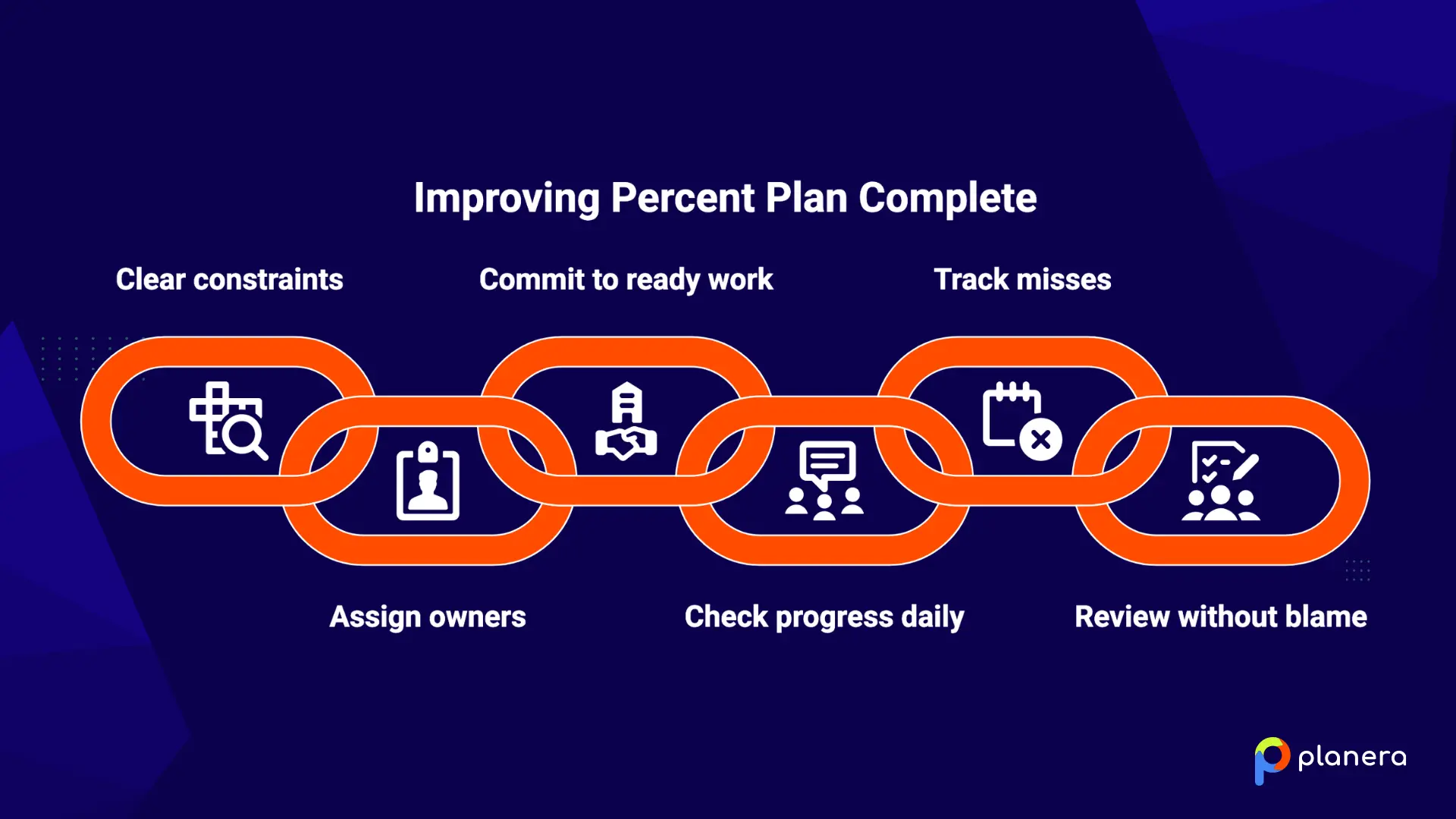
Improving PPC starts with better preparation, not simply asking crews to complete more work. These six steps can help:
- Look ahead and clear constraints: Review upcoming work several weeks ahead, often through pull planning in construction, and resolve constraints before tasks enter the weekly plan.
- Assign owners to constraints: Keep a constraint log with a responsible person and due date for each item.
- Commit only to ready work: Choose clearly defined tasks that are ready to start and fit the crew's actual capacity.
- Check progress daily: Hold short daily huddles to confirm progress and flag blockers before they affect the week's commitments.
- Track reasons for misses: Record why each task was missed, look for recurring causes, and assign someone to address them.
- Review results without blame: Discuss PPC as a team and watch for practices that distort the score, such as adding tasks midweek or repeatedly using vague reasons for missed work.
PPC works best alongside leading indicators that show whether upcoming work is being made ready on time. This gives the team a chance to address problems before they affect the weekly plan. Some teams also use AI in construction to flag likely constraints early, and AI construction scheduling tools can show which planned work is at risk.
How Planera Supports Percent Plan Complete in Construction
PPC is only useful when the weekly commitments and progress data are reliable. That is where Planera brings the planning and tracking together. You can build the weekly plan, lock in committed work, track what happens in the field, and review PPC without maintaining a separate spreadsheet.
- Set and track commitments: Use the project dashboard to compare planned activities with completed activities for a selected period and see your PPC.
- Protect the original plan: Build and adjust work in Planning, then move it to Committed when the team agrees on the plan. Once an activity starts, its committed dates are locked, so later updates do not overwrite what was originally promised.
- Connect field planning to PPC: Use Field Schedules to give trade partners a task-level view of committed work and capture progress from the field.
- Understand why work was missed: Use variance reason codes to record issues such as weather, resource constraints, or other delays. Instead of seeing only a lower PPC, you can see what caused it.
- See where reliability is changing: Review PPC over time, drill down by code, or filter the results to critical path activities to see where planning reliability needs attention.
- Keep the schedule and field plan connected: Progress from field activities can flow back into the broader schedule, so PPC becomes part of the same planning cycle rather than a separate weekly report.
Book a demo to see how Planera tracks PPC on a schedule like yours, including data center construction.
FAQ
What is percent plan complete in construction?
Percent Plan Complete (PPC) is a weekly reliability metric that shows the percentage of committed tasks crews completed as planned.
What is the PPC formula in construction?
PPC = Completed Planned Tasks ÷ Total Planned Tasks × 100
Only count tasks that were part of the original weekly commitment.
How do you calculate percent plan complete?
Count the committed tasks completed in full, divide that number by the total committed tasks, and multiply by 100. If a team completes 9 of 12 tasks, its PPC is 75%.
What is a good percent plan complete in construction?
There is no universal target, but many teams use 70% or higher as a general reference point. Context and the trend over time matter more than a single score.
What does 100% PPC mean in construction?
It means every committed task was completed during the week. A 100% score can be positive, but consistently perfect scores may indicate that the team is under-committing.
What causes a low PPC score?
Common causes include late materials, labor or equipment shortages, incomplete predecessor work, design delays, access constraints, and unrealistic weekly commitments.
How often should percent plan complete be calculated?
Calculate PPC once a week at the end of the work week, then track the results over time to identify trends and recurring problems.
What is the difference between PPC and schedule variance?
Schedule variance compares actual progress with the project baseline schedule, which is often built using CPM in construction. PPC measures how reliably the team completes its weekly commitments. A project can be on schedule while still having a low PPC.
How does PPC support the Last Planner System?
PPC measures whether weekly commitments were completed. Recording the reasons for missed commitments helps teams learn from those misses and improve future planning.
How can construction teams improve PPC?
Clear constraints before work is committed, choose tasks that are ready and fit the crew's capacity, track progress during the week, and address recurring reasons for missed commitments.

You deserve better scheduling software.
Drive revenue, reduce costs, and manage scheduling with Planera.
Request a Demo


.webp)