


Data center construction is becoming a major investment in the US. The value of data center projects that began construction reached $81.5 billion through June 2026, already exceeding the $72.5 billion recorded across all of 2025.
Building a data center is also more complex than building a typical commercial facility. Grid capacity, long-lead electrical equipment, specialized cooling systems, and permitting requirements can all affect the project schedule.
This guide covers the 10 main phases of data center construction, how long each phase can take, what commonly causes delays, and how construction teams can keep the project on track.
What Is the Data Center Construction Process?
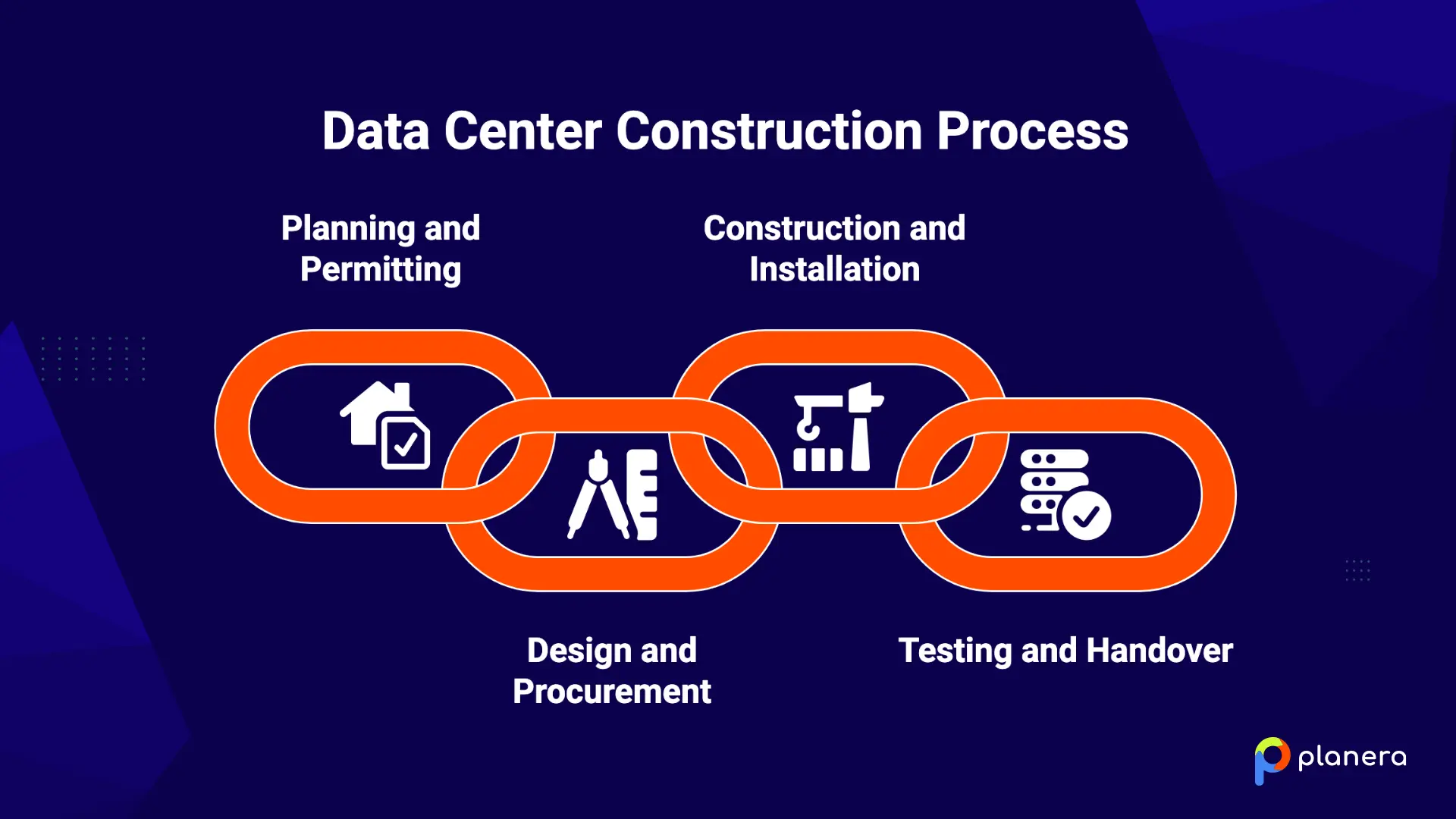
The data center construction process is the series of steps that takes a project from site selection to commissioning and operational turnover. It includes planning, permitting, design, procurement, civil work, building construction, MEP installation, network setup, testing, and handover to operations.
These phases are closely connected, so a detailed construction schedule is important for coordinating dependencies and understanding how a delay in one phase can affect the work that follows. For example, a delayed utility route can hold up site work, while late delivery of a generator can delay electrical installation.
The project is ultimately working toward a ready-for-service (RFS) date. This is when the facility has been energized, commissioned, and is ready to be handed over to the operations team. Reaching construction completion alone does not mean the data center is ready to operate.
What Are the Main Steps in the Data Center Construction Process?
The process typically runs through 10 phases, although they do not always happen one after another. On construction fast tracking projects, some activities overlap. Procurement can begin before design is complete, while MEP installation can start as sections of the building become ready.
Phase 1: Site Selection and Feasibility
Teams assess grid capacity, fiber connectivity, water supply, zoning, flood exposure, and local labor availability when evaluating a site. Grid access can be a major constraint. JLL reports that grid connection waits can exceed four years in some primary markets.
Phase 2: Project Planning and Design Development
Design teams develop the electrical, mechanical, structural, and architectural plans, including the required level of redundancy. Rack density is an important consideration because higher-density equipment can increase power and cooling requirements. AFCOM's 2026 report puts average rack density at 27 kW per rack, up from 16 kW the year before.
Phase 3: Permitting and Regulatory Approvals
Teams secure the permits required for construction and operation, which can include zoning, environmental, air, and water approvals. Backup generators may require air permits, while cooling systems can involve water-related approvals. In some cases, a permit resubmission can add months to the schedule.
Phase 4: Procurement and Long-Lead Equipment
Procurement needs to start early for equipment with long manufacturing lead times. Wood Mackenzie data reported by Data Center Knowledge shows that substation transformer lead times exceeded 160 weeks in 2026, compared with about 140 weeks in 2023. Coordinating procurement with design helps teams secure equipment while ensuring specifications match the latest plans.
Phase 5: Site Preparation and Civil Construction
Crews clear, grade, and excavate the site before installing drainage, access roads, laydown areas, utility pathways, grounding systems, and foundations. Broadstaff estimates that this work typically takes 2 to 6 months. Delays or problems with site preparation can affect foundation work and other activities that follow.
Phase 6: Structural Construction
This phase includes the structural frame, tilt-up or precast panels, roof, and building envelope. OpenSpace notes that the pace of shell construction affects when other trades can begin their work. Poor coordination between structural work and MEP installation can create access issues and rework.
Phase 7: Electrical and Mechanical Installation
Crews install major systems such as switchgear, UPS systems, generators, chillers, cooling systems, fire suppression, and controls. This phase involves several trades working in the same areas, so a clear construction sequence plan can help coordinate the order of work, trade handoffs, and access. As installation progresses, completed systems can also limit access for later work.
Phase 8: Data Hall Fit-Out
The team installs racks and cabinets, fiber and cable tray, patch panels, and network equipment. Equipment is labelled and documented as installation progresses. Good coordination at this stage helps reduce problems during testing and turnover.
Phase 9: Testing and Commissioning
Commissioning moves from individual equipment checks to functional testing and integrated systems testing (IST). Anvilfield describes the IST as testing the facility under load and simulating conditions such as utility loss to verify how systems respond together. Commissioning levels can be numbered differently between firms, so project teams should agree on the testing framework at the start.
Phase 10: Turnover and Operational Readiness
Turnover transfers the completed facility to the operations team. The handover package can include O&M manuals, as-built drawings, test reports, warranty information, training records, and the final punch list. The facility should only move into operational use once required testing is complete and outstanding critical issues have been resolved.
How Long Does the Data Center Construction Process Take?
A full data center project can take 3 to 6 years from site selection through commissioning. Vertical construction typically takes 12 to 36 months. For hyperscale facilities, OpenDock reports timelines of around 18 to 24 months from planning to deployment.
Here is a typical breakdown of the major stages:
| Phase | Typical Range |
|---|---|
| Site selection | 6 to 12 months |
| Design and preconstruction | 9 to 18 months |
| Permitting | 6 to 18 months |
| Vertical construction | 12 to 36 months |
| Commissioning and energization | 3 to 9 months |

These phases can overlap, so the ranges should not be added together. The overall schedule can also change based on grid availability, project size, equipment lead times, permitting, and site conditions.
Modular delivery can shorten the timeline in some cases. Highly modularized projects have achieved delivery timelines of 12 to 16 months, compared with 24 to 36 months for some conventional approaches. These figures are project-specific and should not be treated as a standard timeline.
What Factors Affect the Data Center Construction Process?
Several factors can affect how quickly a data center project moves from planning to turnover. The most important include:
- Data center size and capacity: Larger facilities generally require more infrastructure, equipment, and coordination. Project duration is influenced more by power capacity than square footage.
- Site conditions and location: Grid access, water availability, local regulations, labor supply, and site conditions can all affect the schedule.
- Power availability: Access to sufficient grid capacity can determine when construction can begin and how quickly the facility can be energized. 48% of respondents identified grid supply as the biggest obstacle to on-time delivery.
- Cooling requirements: Higher rack densities can require more advanced cooling systems, adding mechanical work and testing to the project.
- Design complexity and redundancy: Requirements such as N+1 or 2N redundancy add equipment, installation, and testing requirements.
- Equipment lead times: Long lead times for transformers, switchgear, generators, and other critical equipment can affect installation and commissioning dates. JLL reports an average global equipment lead time of 33 weeks, 50% above pre-2020 levels.
- Permitting and regulatory requirements: The number and complexity of required approvals vary by location and project. Delays can prevent site work or other activities from starting on time.
- Construction method and project delivery model: Prefabrication can move some work off-site and reduce on-site activity. Prefabrication can cut site deliveries by 60% to 70%, although teams still need to coordinate module interfaces and installation.
How Do You Manage a Data Center Construction Project?
Managing a data center construction project requires close control of the schedule, dependencies, progress, and changes. Key practices include:
- Create a detailed construction schedule: Link civil, structural, MEP, procurement, and energization activities to realistic delivery dates.
- Define dependencies between activities: Show what needs to be completed before each trade or activity can begin.
- Track critical path activities: Monitor activities with little or no float, especially long-lead equipment and work tied to energization and commissioning. A construction milestone schedule can help teams keep visibility over key delivery dates across each phase.
- Coordinate contractors and trades: Keep teams aligned on work areas, access, sequencing, and handoffs to reduce conflicts and rework.
- Monitor construction progress: Compare actual progress with the schedule and document completed work before it becomes inaccessible or covered by later installations.
- Manage changes and schedule risks: Assess the impact of design changes, procurement issues, and site conditions before they affect downstream activities.
- Use lookahead planning for site teams: Three- to six-week lookaheads connect upcoming field work with the construction master schedule and help teams address constraints early. Pull planning in construction is one method teams use to build these lookaheads with input from trade foremen and field crews.
What Role Does Construction Scheduling Software Play in Data Center Projects?
Data center projects can involve thousands of linked activities across procurement, construction, MEP installation, testing, and commissioning. A change to one activity can affect several others, making schedule visibility important.
Construction scheduling software gives project managers, superintendents, and schedulers a shared view of these dependencies. Teams can track the critical path, update progress, manage resources, and see how changes affect the planned completion date.
It also supports scenario planning. Teams can test what happens if a chiller is delayed, crews are added, or work is resequenced before changing the active schedule. This helps them identify potential constraints and make schedule adjustments earlier.
Best Practices for a Successful Data Center Construction Process
A few practical habits can help teams reduce avoidable delays and keep the project moving:
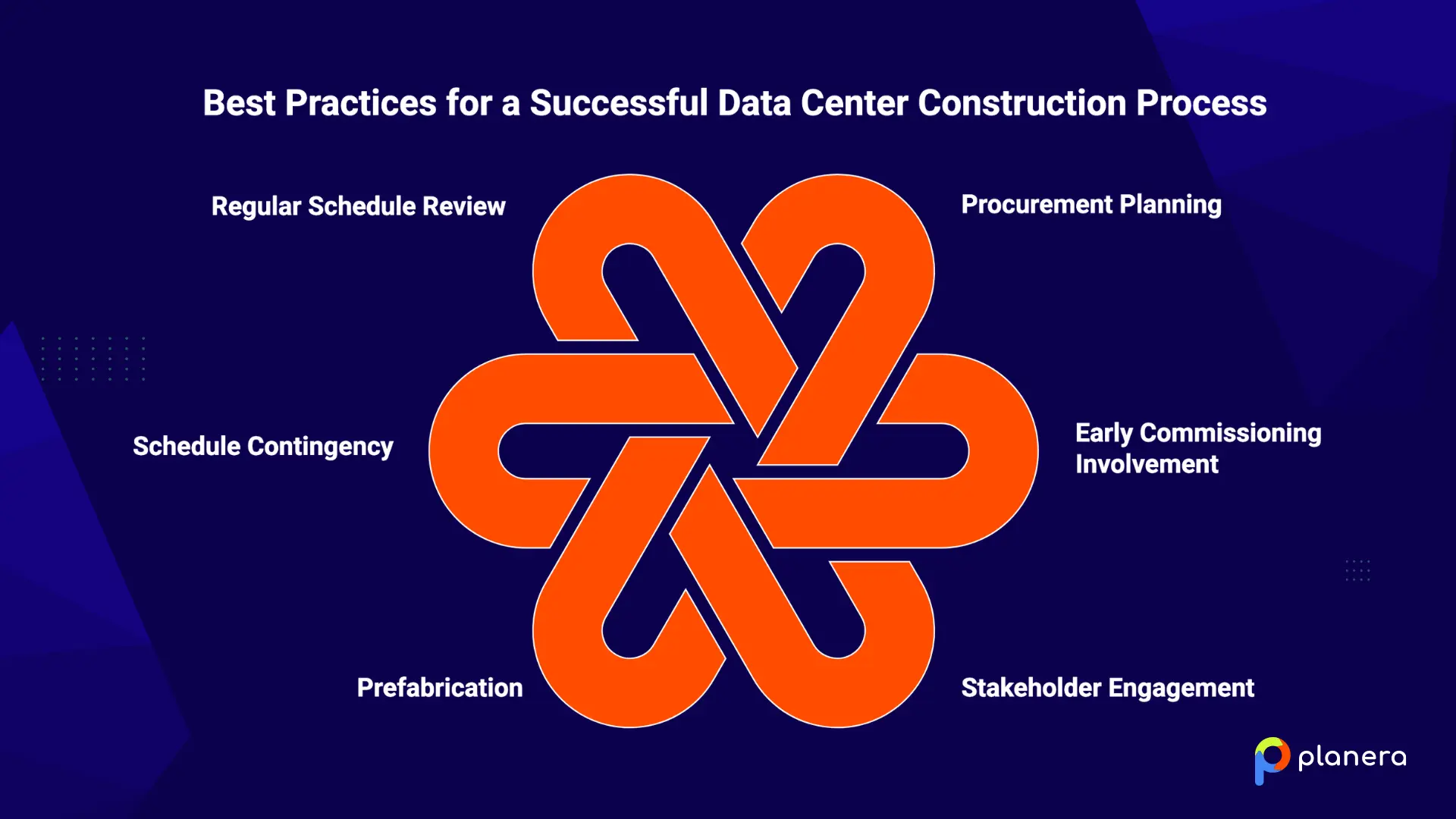
- Plan procurement around the schedule: Identify critical equipment early and connect delivery dates to installation and commissioning activities.
- Involve commissioning teams early: Bring commissioning specialists into the project before installation is complete so testing requirements are considered during construction.
- Engage utilities and local stakeholders early: Confirm utility requirements, approvals, and other external dependencies before they become schedule constraints.
- Use prefabrication where it makes sense: Move suitable components off-site to reduce on-site work and allow some activities to happen in parallel.
- Build schedule contingency into the plan: Allow for uncertainty around permitting, equipment delivery, design changes, and other risks rather than planning around ideal conditions.
- Review the schedule regularly: Update progress, reassess dependencies, and adjust upcoming work as project conditions change.
How Planera Supports the Data Center Construction Process
Data center schedules need to connect procurement, construction, and commissioning rather than treating them as separate plans. Planera helps teams link these activities in one CPM schedule, so a change to an equipment delivery or installation activity can be traced through its downstream dependencies.
Teams can import XER, XML, and MPP files and export schedules back to P6 or Microsoft Project when required. This makes it easier to work with existing project schedules without rebuilding them from scratch.
Planera also supports Monte Carlo simulation and AI in construction schedule analysis. Teams can use these tools to assess schedule uncertainty, identify potential risks, and understand how changes could affect the planned completion date. Lookahead planning can then connect upcoming field activities with the master schedule.
Book a Planera demo to see how it can support a data center construction schedule.
FAQ
What are the main phases of data center construction?
The process typically covers site selection, planning and design, permitting, procurement, site preparation, structural construction, MEP installation, data hall fit-out, commissioning, and turnover.
What happens during data center site preparation?
Crews clear and grade the site, install drainage and utility pathways, prepare access roads and laydown areas, and build foundations and grounding systems. This phase typically takes 2 to 6 months.
How are electrical and cooling systems installed in a data center?
Electrical and mechanical trades install systems such as switchgear, UPS units, generators, chillers, cooling loops, controls, and fire protection. The work must be carefully sequenced because several trades often work in the same areas.
Why is commissioning important in data center construction?
Commissioning verifies that individual systems and the facility as a whole operate as intended. Integrated systems testing also checks how systems respond together during conditions such as power loss or equipment failure.
What happens during data center turnover?
The completed facility is handed over to the operations team along with O&M manuals, as-built drawings, test reports, warranty information, and training records. Outstanding critical issues should be resolved before the facility enters operation.
How long does the data center construction process take?
A full project can take 3 to 6 years from site selection through commissioning. Vertical construction typically takes 12 to 36 months, depending on the project.
What can delay data center construction?
Common causes include limited grid capacity, long equipment lead times, permitting delays, labor shortages, design changes, and problems discovered during testing or commissioning.
What is the difference between data center construction and fit-out?
Construction establishes the site, building shell, and major infrastructure. Fit-out focuses on the data hall, including racks, cabling, network equipment, containment, and other systems needed for operation.
What systems need to be tested before a data center goes live?
Teams test electrical, mechanical, cooling, controls, fire protection, and monitoring systems. Integrated testing then checks how these systems respond together under normal and failure conditions.

You deserve better scheduling software.
Drive revenue, reduce costs, and manage scheduling with Planera.
Request a Demo